A Conversation with Susan Gaire About the Tapestry Interest Group at Local Cloth

On March 29, 2026, I chatted with Susan Gaire about the Tapestry Interest Group at Local Cloth. Their newly completed project had drawn my attention at the Local Cloth Studio in the River Arts District.

Susan led me through the group’s inspiration, her participation in organizing the project, and the group’s collaborative interactions in completing the work. Susan is highly energetic and enthusiastic about the tapestry project.
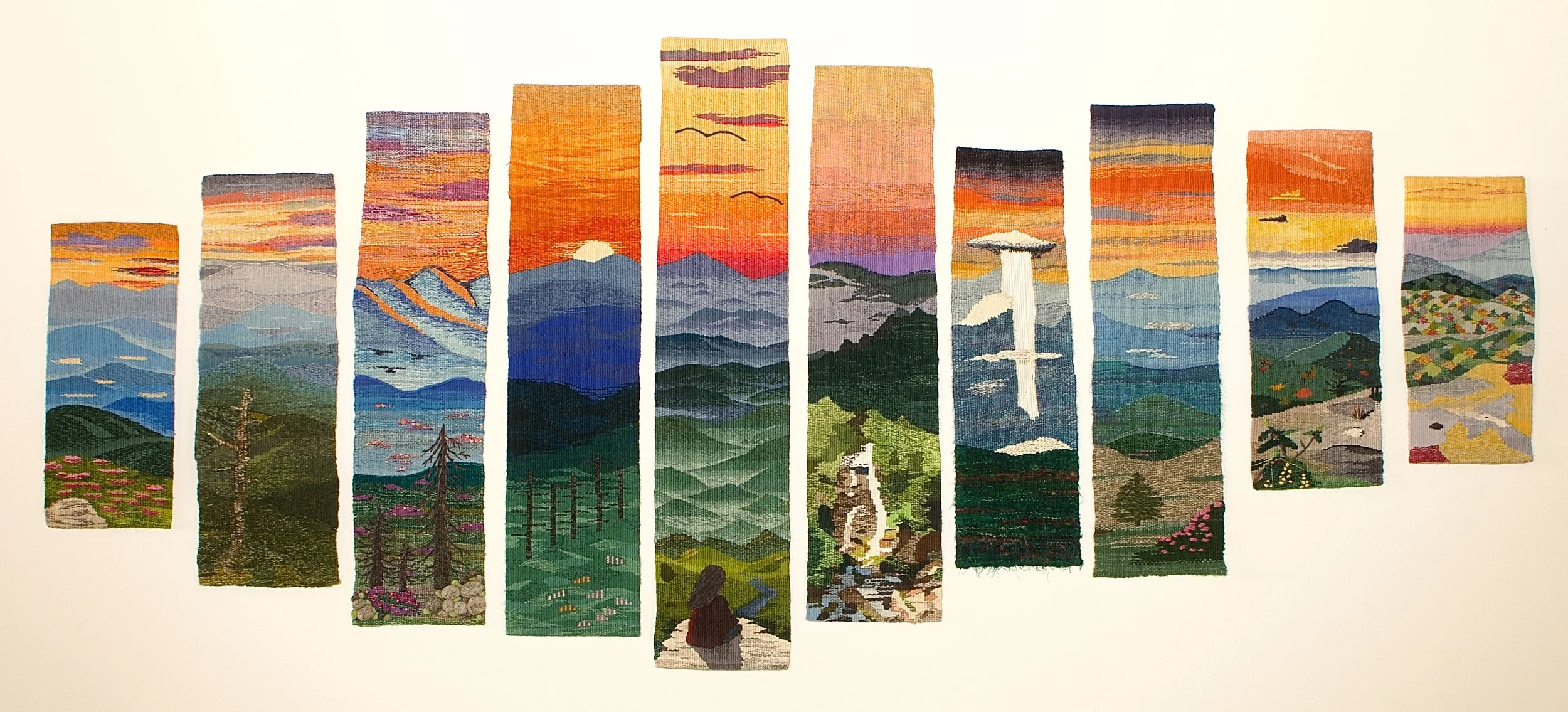

Blue Ridge Mountain Collaborative Tapestry Postcard

Location: Local Cloth, Asheville, NC March 17, 2025

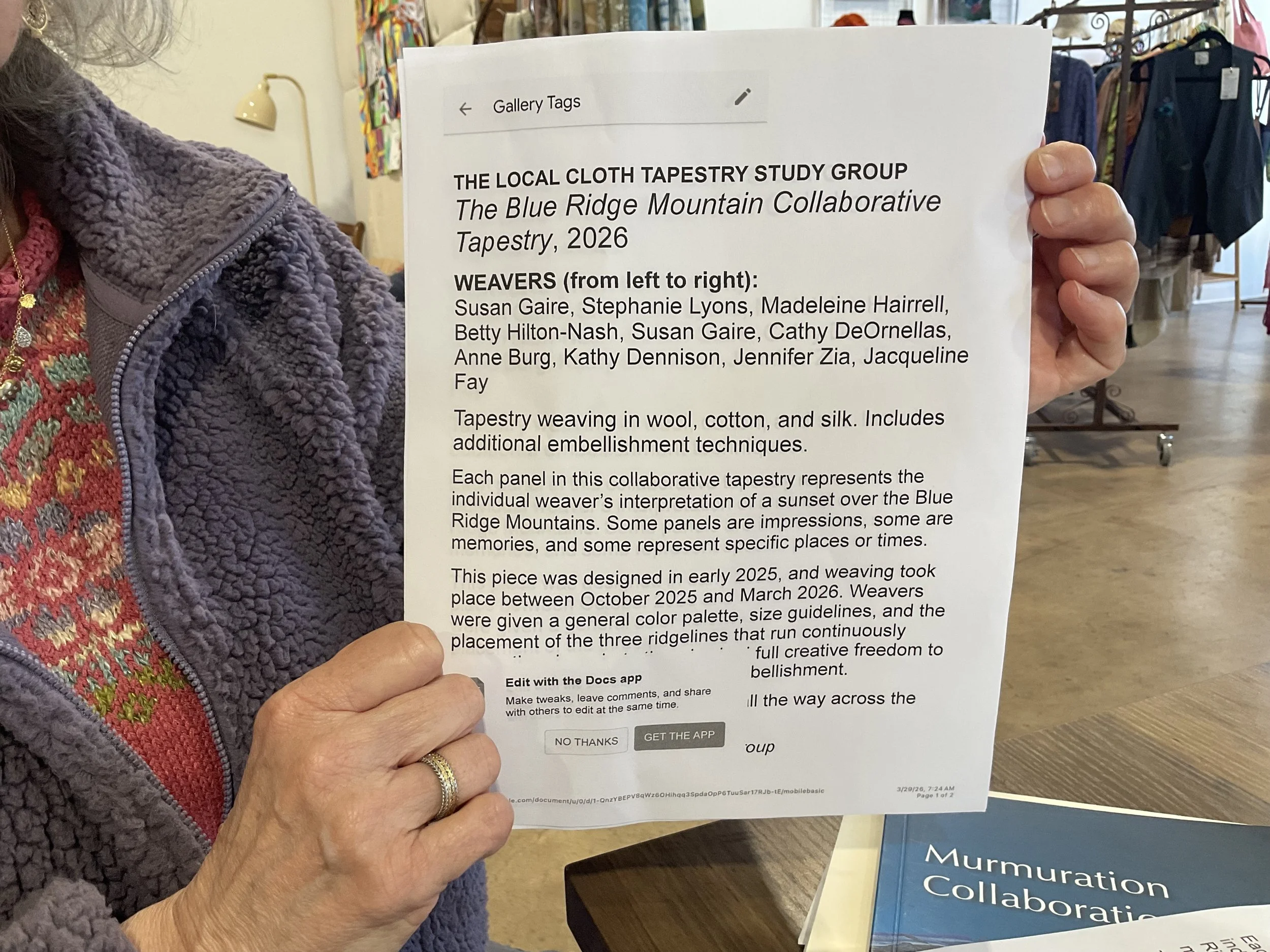
Weavers from left to right:

Susan Gaire, Stephanie Lyons, Madeleine Hairrell, Betty Hilton-Nash, Susan Gaire, Kathy DeOrnellas, Anne Burg, Kathy Dennison, Jennifer Zia, Jaqueline Fay

Size: 7’ x 3’

Materials: warp: cotton seine twine, weft: wool, silk, assorted fibers.


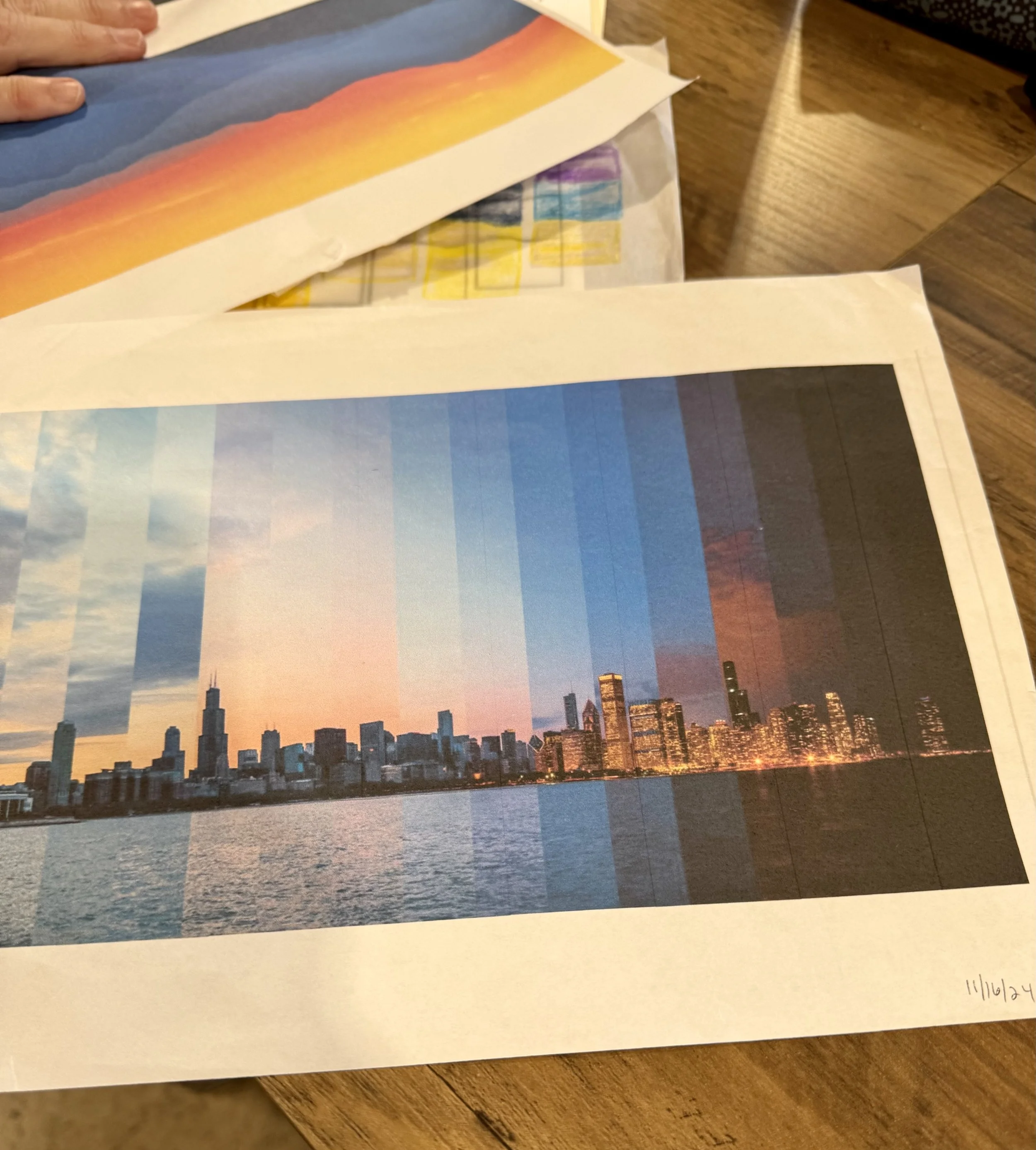
First, Susan Gaire showed me the folder she created for this project. She had collected photos of a project in which the same city view was photographed at different times. Slices of the images were extracted and reassembled so that, from left to right, a progression from day to night could be seen. One common element in their composition is the water-land interface.
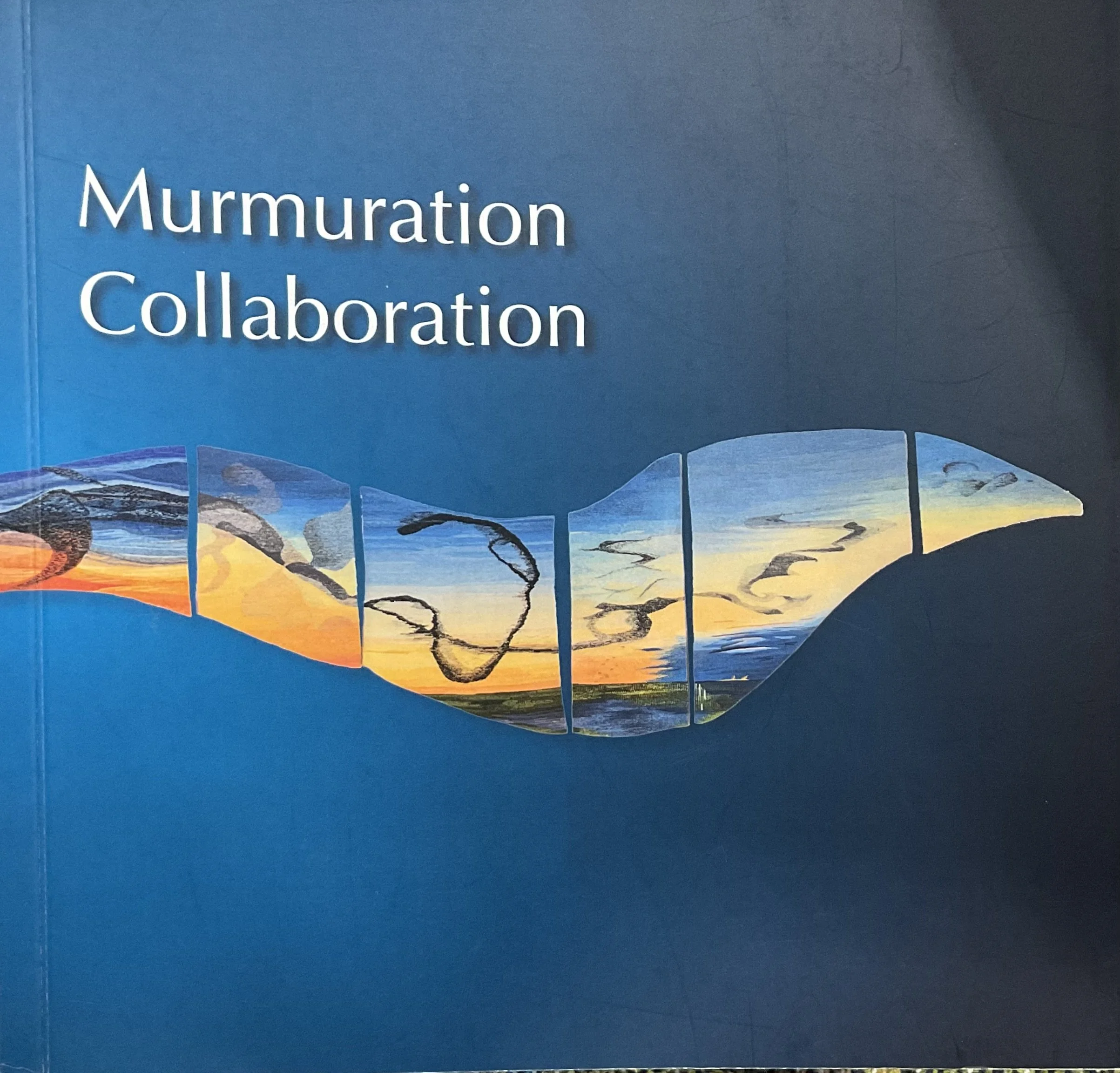
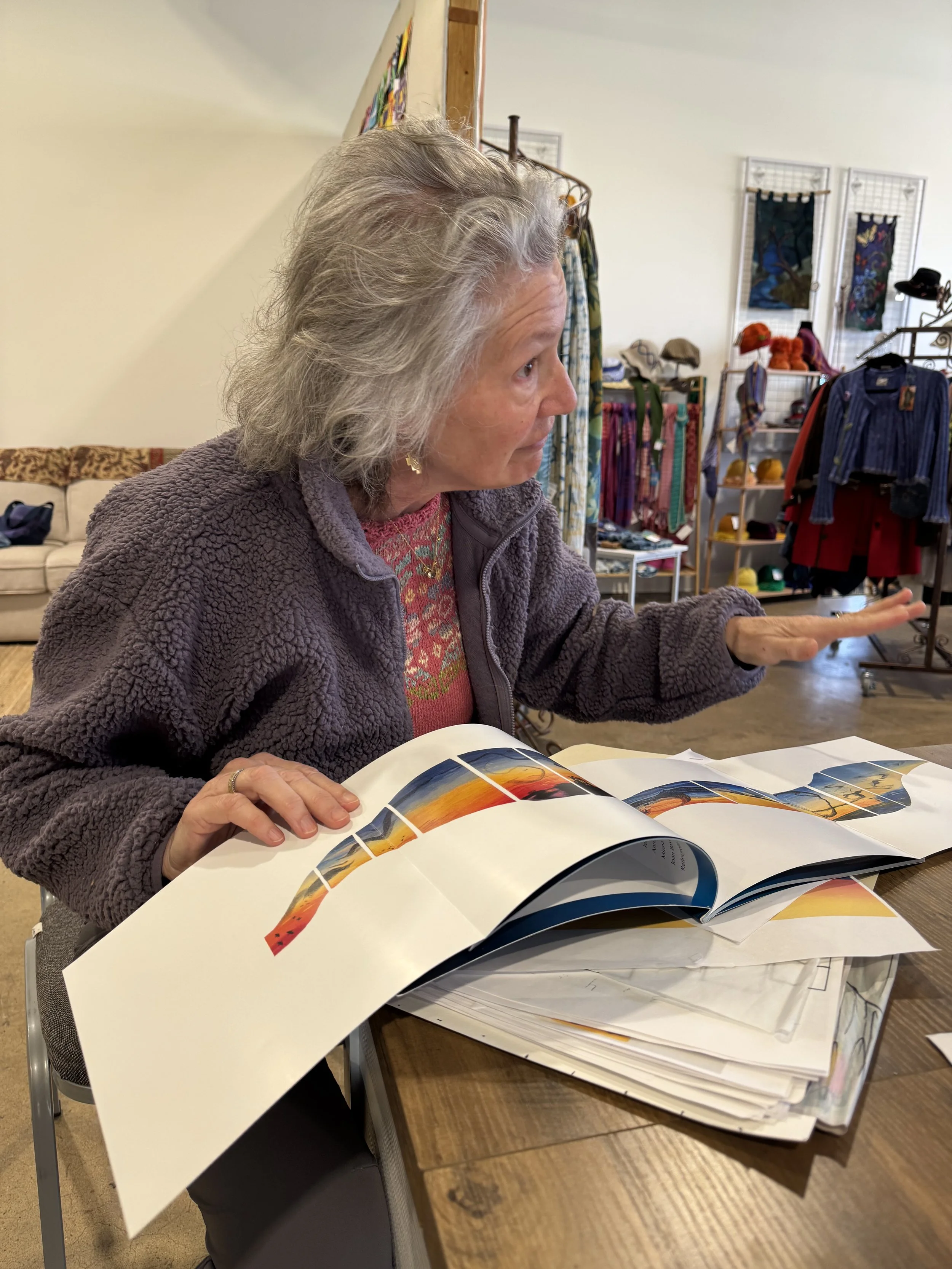
The tapestry project was also highly influenced by another tapestry artist collaboration, The Murmuration Collaboration.

The Murmuration Collaboration

Susan Gaire showed me the foldout page from the Murmuration catalog publication.
We live in the beautiful mountains of Western North Carolina, which provided the next major influence for the textile interest group project.
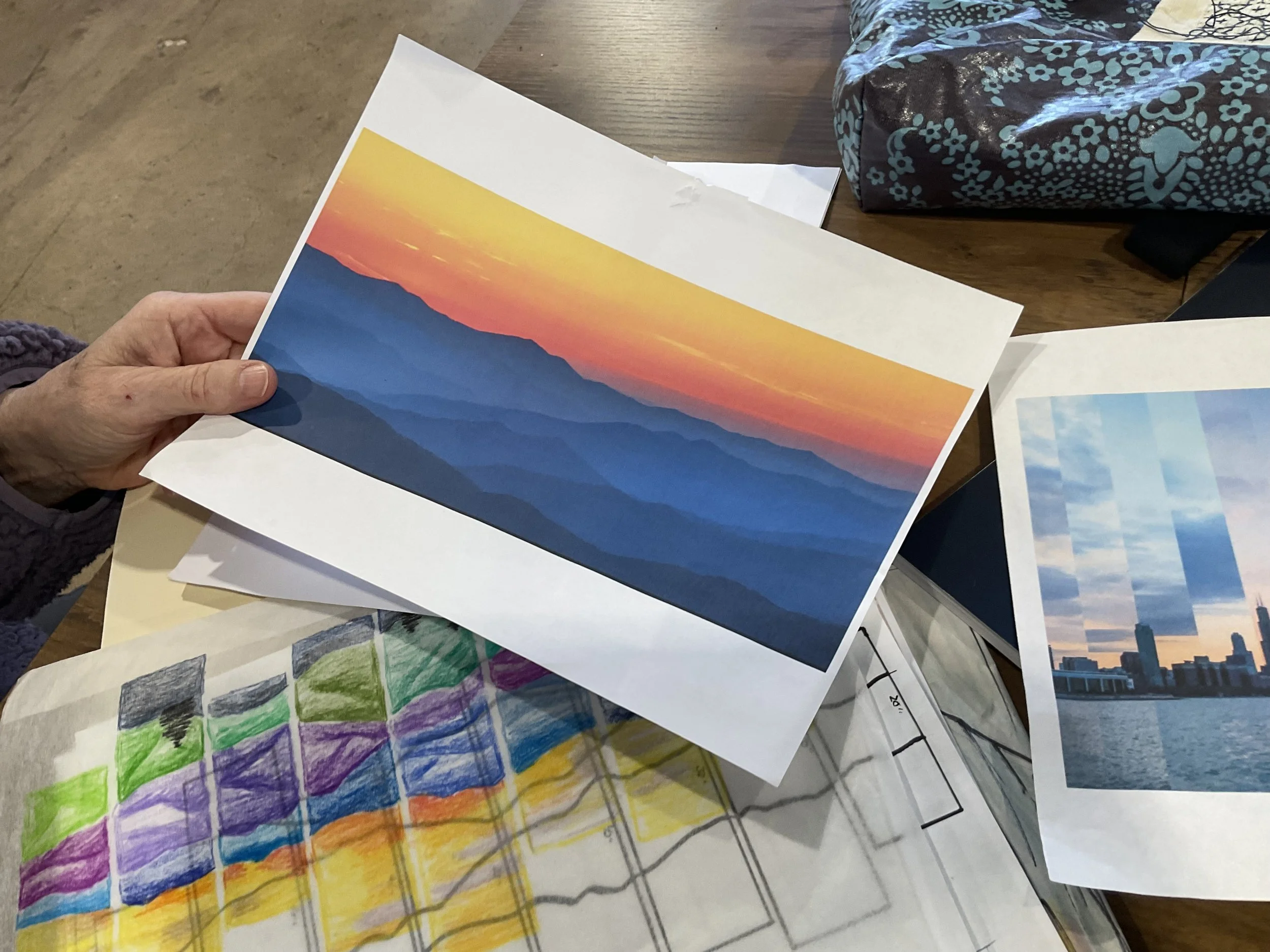

The group worked on colored-pencil renditions of a beautiful photograph of the mountains at sunset and chose three strong ridgelines to act as the continuity thread between the individual contributions of the tapestry members.
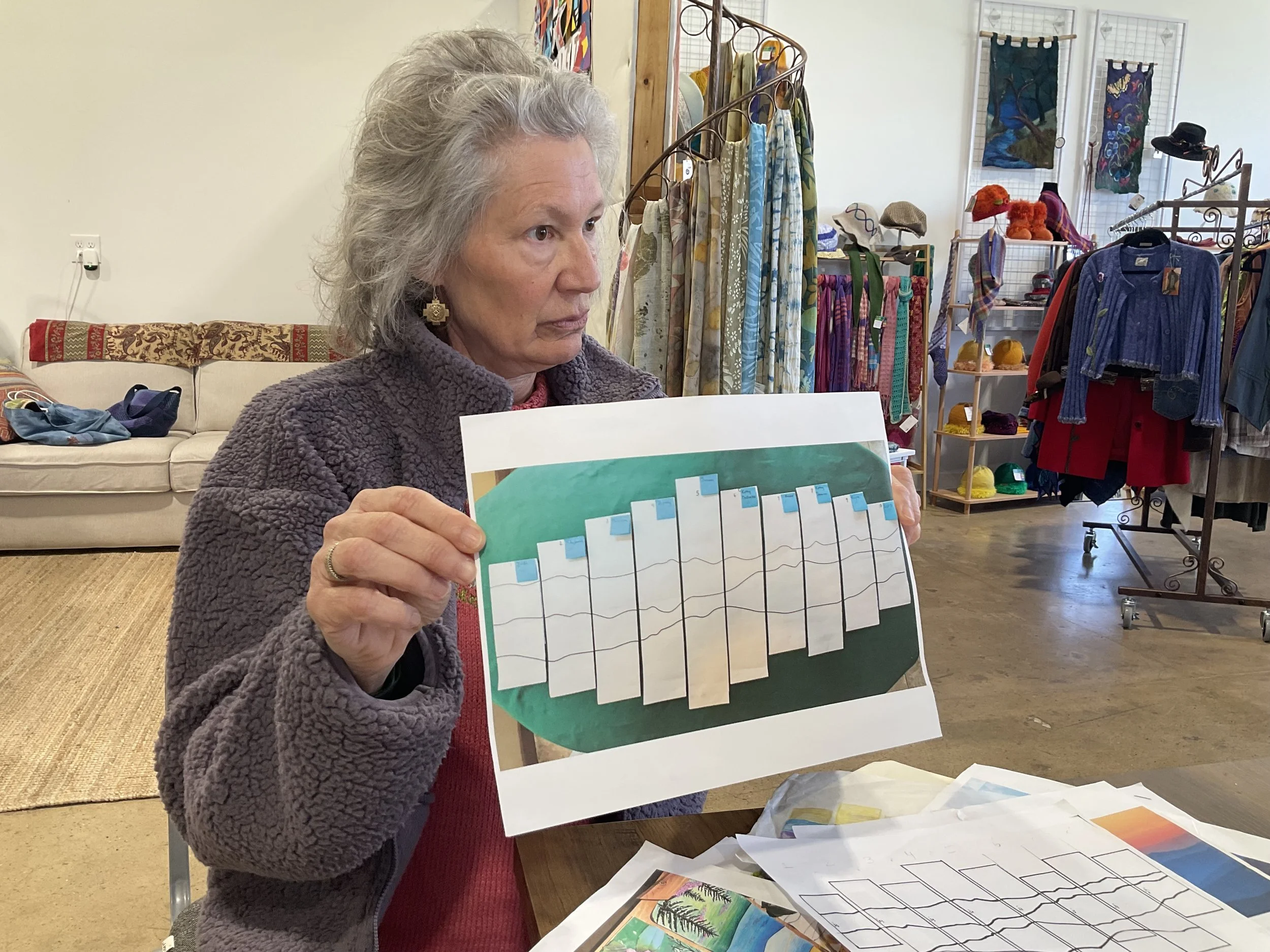
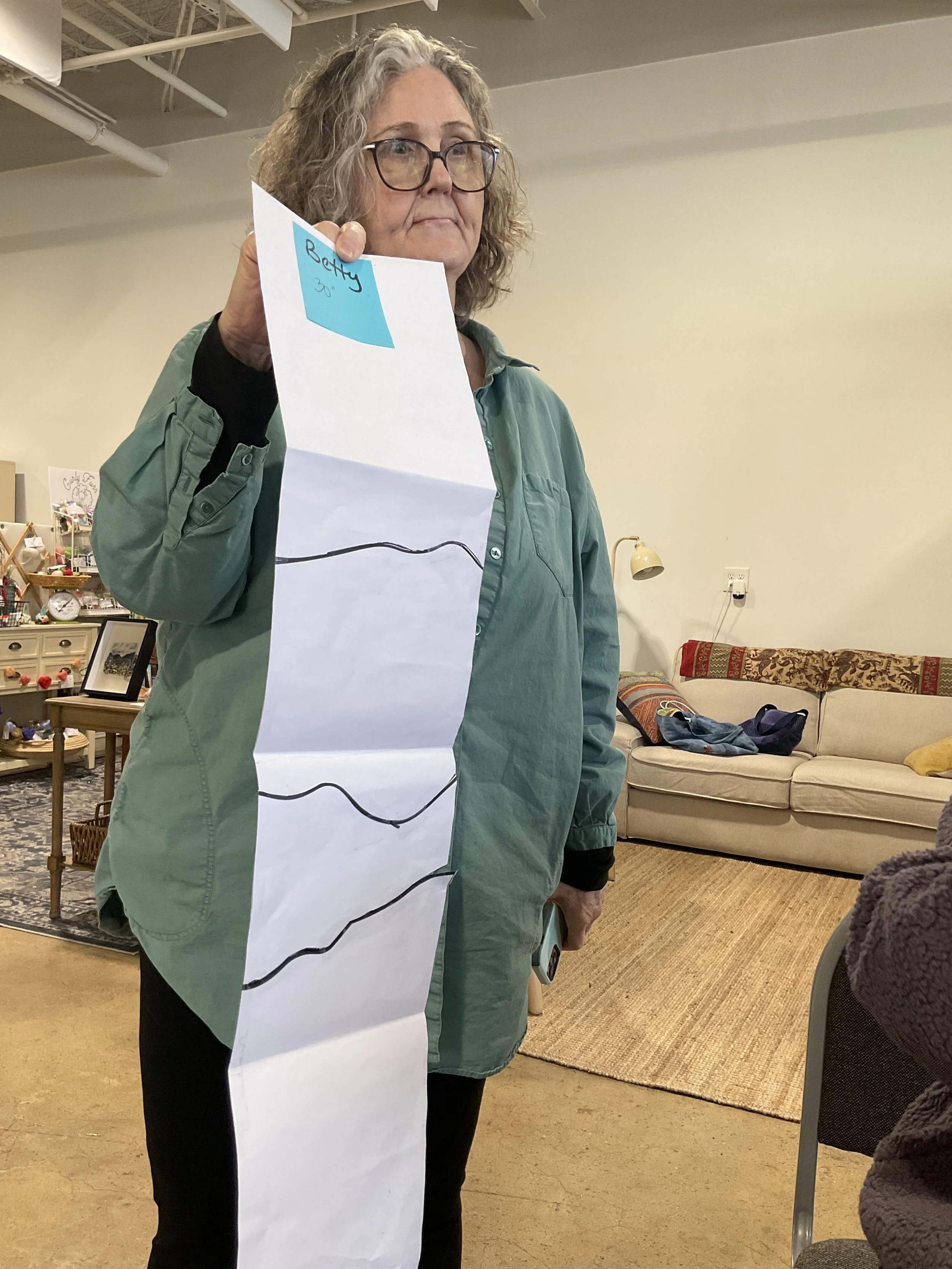
From there, full-size strips matching the actual dimensions of the individual contributions were drawn, and the three ridgelines were penciled in. They were cut out and handed to each of the participants. Betty Winters is shown holding her pattern piece.
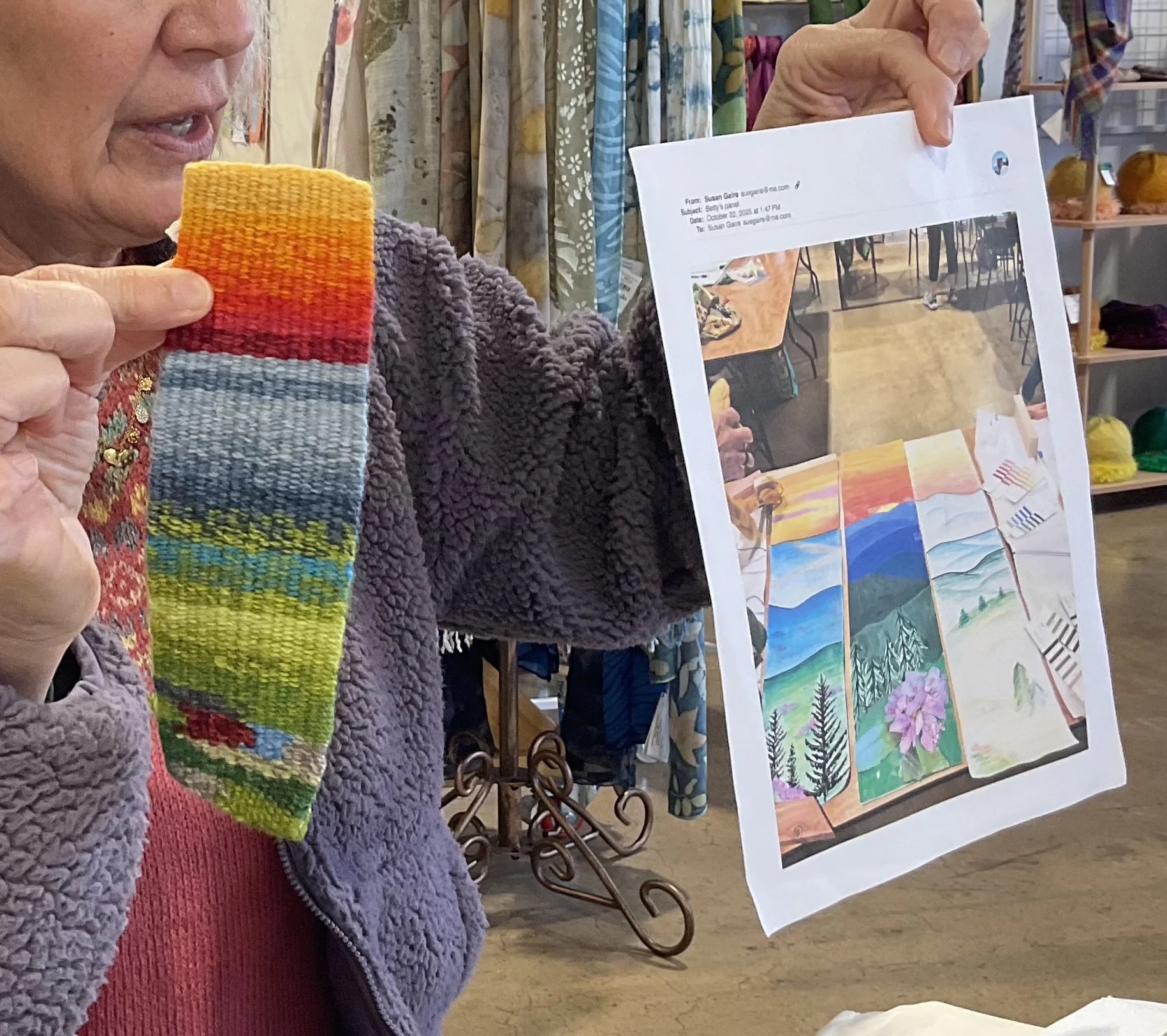
Individuals created sketches and small samples containing the yarns to be used so they could compare them for compatibility. You can see that the textile group collaborators have strong talent in coloring and drawing the mockups.

A deadline was set for April 2026, and they went to work.
Local Cloth Waterline Project

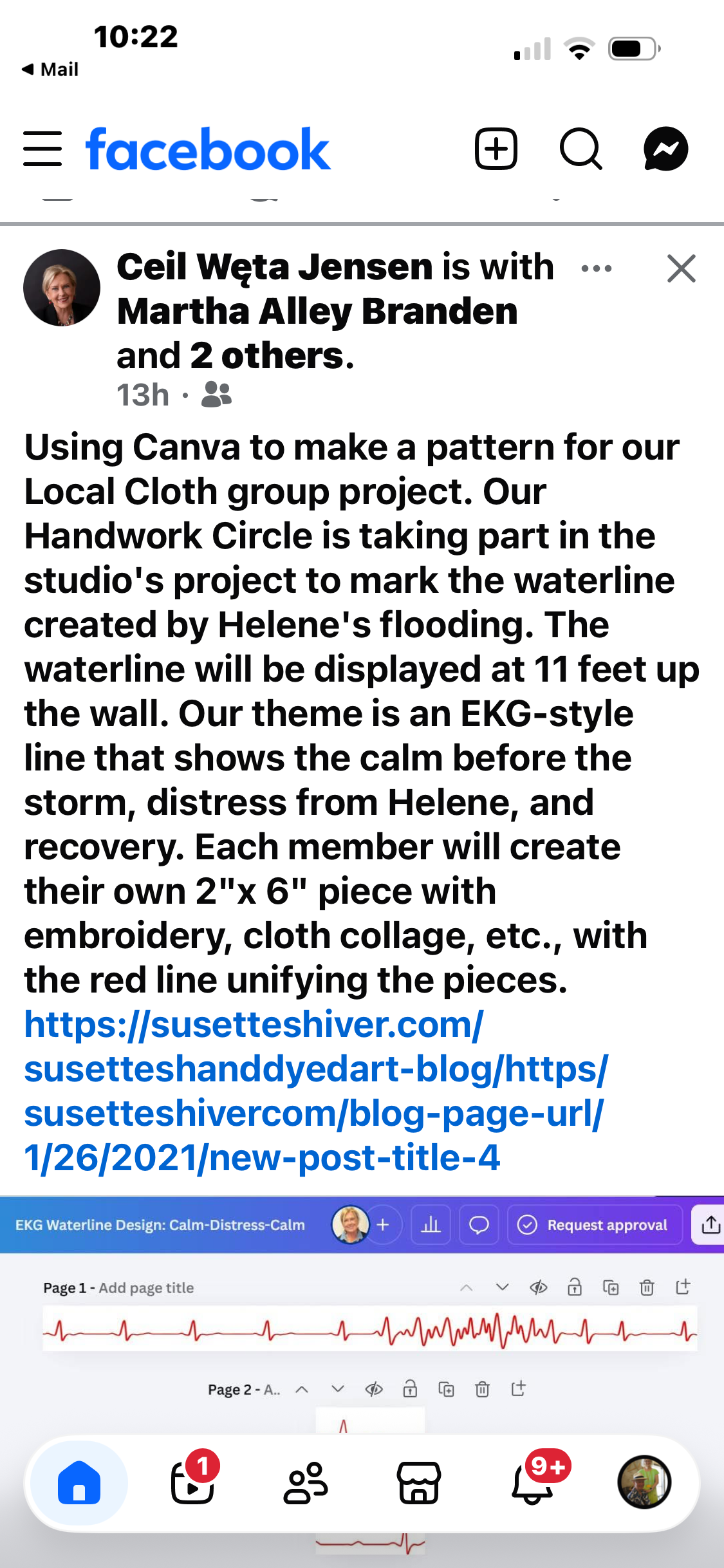
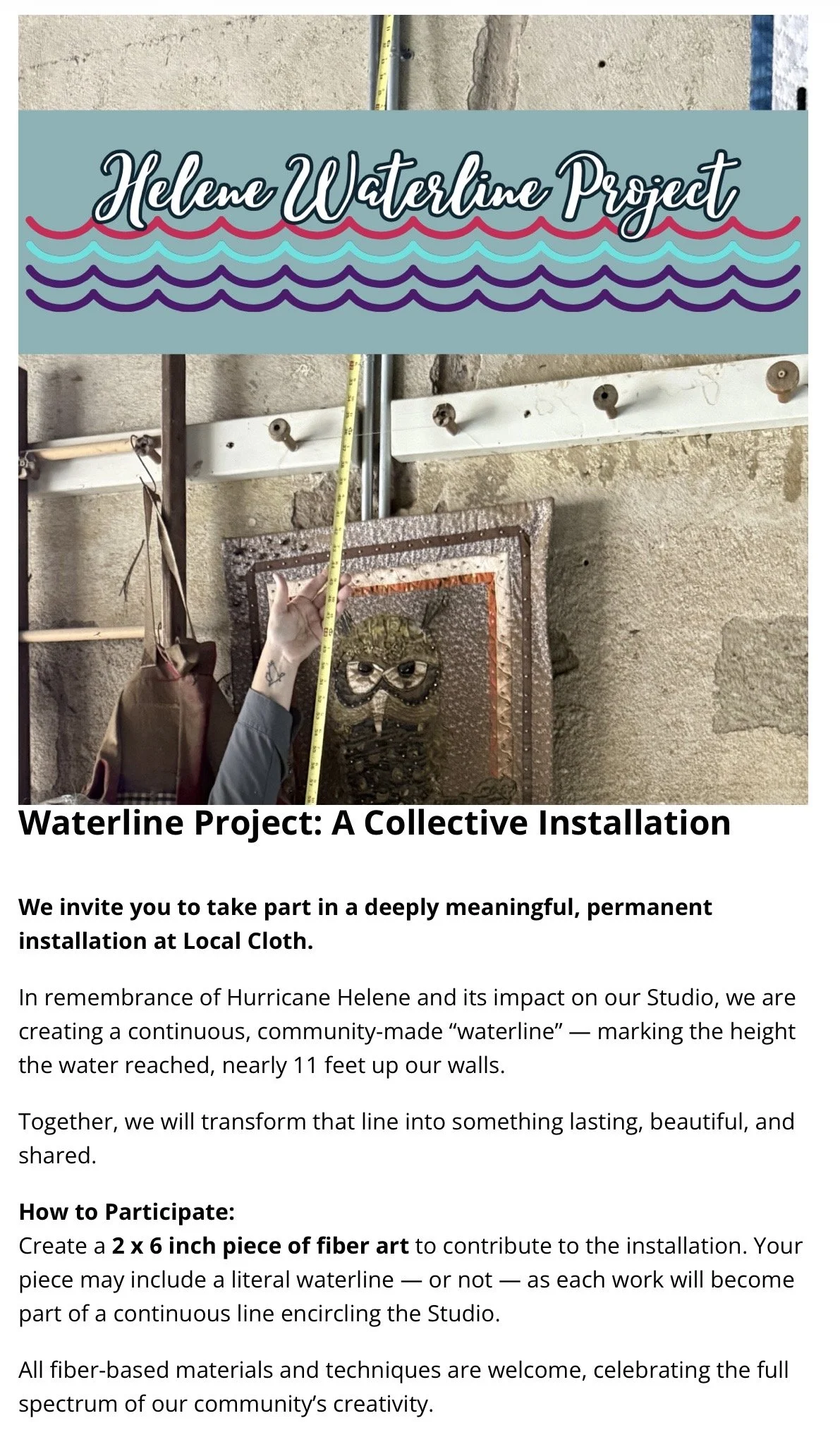
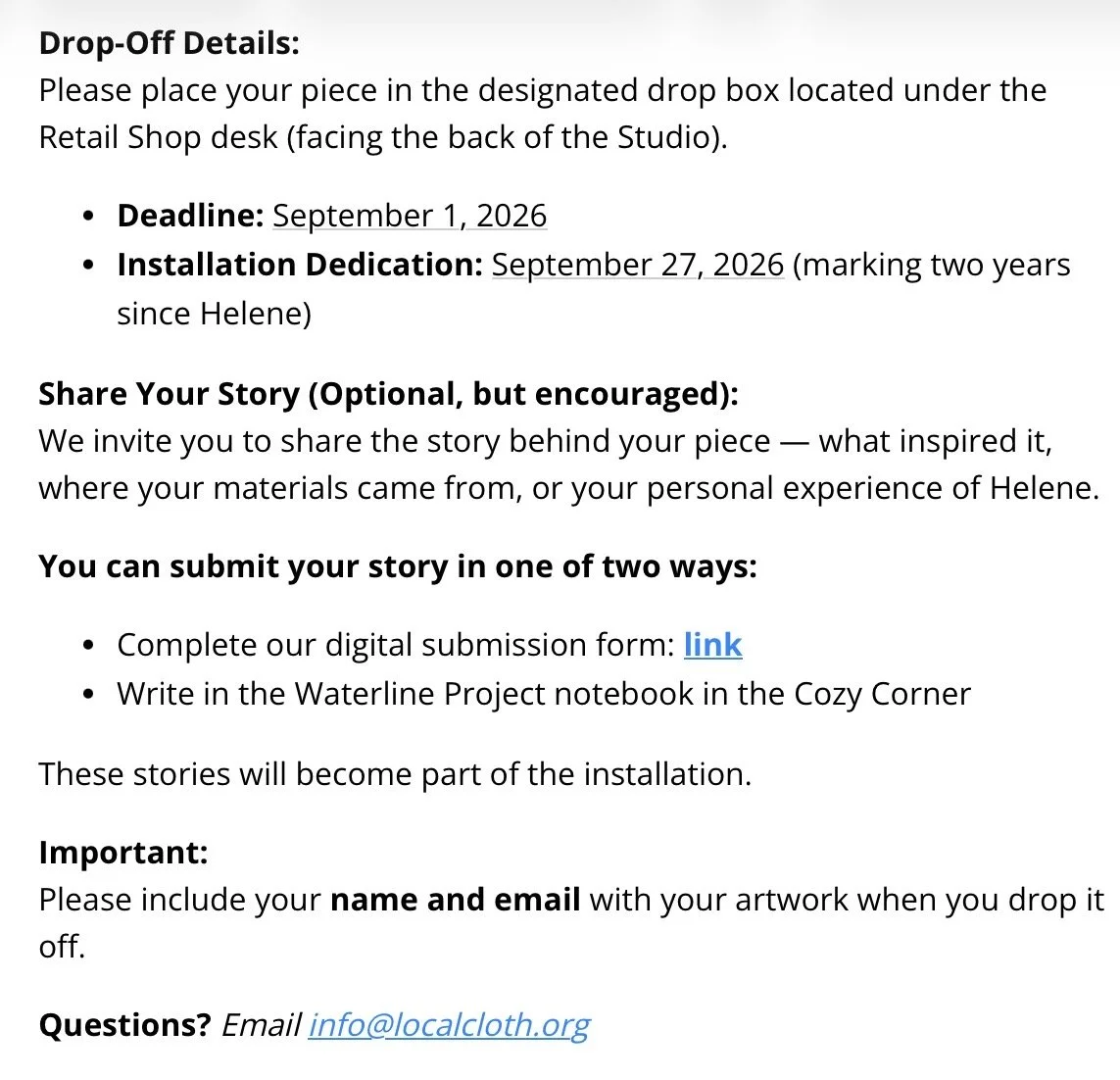
The details of the Post-Hurricane Helene member project were sent to Local Cloth members in an email. I captured this information in the screenshots below.

Our Handwork Circle at Local Cloth decided to approach this as a group. We discussed it during our online Zoom gathering today. We volunteered several ideas and identified felt as a possible medium. Several of us have nice collections of felt in different colors.

At the bottom of each 2” × 6” piece, we felt that browns would be especially relevant to the project. The water that filled our studio in the wake of Hurricane Helene was filled with brown sludge from the French Broad River. Above the sludge-colored water in our pieces, however, colorful objects — including flowers and other scenes along Depot Street — might provide a brighter aspect that mirrors our recovery. That is where we are thus far.

The pieces must be delivered by September 1, 2026, so that is our deadline. Since this is a group project, we want to link our 2” × 6” pieces together in a chain and submit them that way.

There are two ways to submit:

  1. Enter it in the Waterline project book in Local Cloth’s cozy corner.

  2. Submit it online:

Waterline Project Submission Form


Update — May 2, 2026, on the Handwork Circle’s Planned Contributions

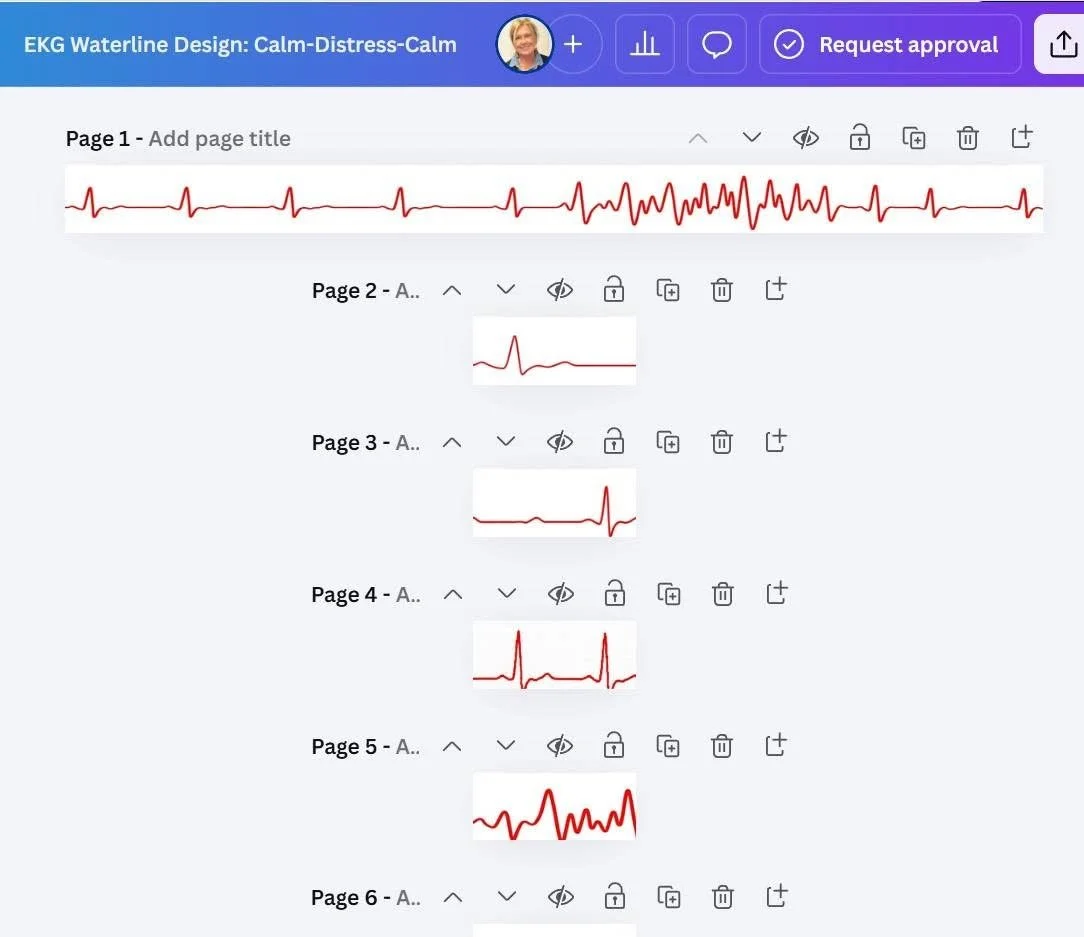
The Handwork Circle contribution, we decided, will consist of joined individual pieces unified by a heartbeat motif: the tracing of a heart monitor. We discussed ideas for designing the 2” × 6” strips that will be arranged horizontally 11 feet up the wall. The earlier idea of requiring brown and other shared colors for everyone to use was ultimately discarded.

We were inspired by the Tapestry Interest Group’s installation at the Local Cloth Studio.

Chatting with Susan Gaire About the Tapestry Interest Group at Local Cloth

Ceil volunteered to create and distribute paper templates after designing the heartbeat line digitally. At present, we feel participants should have the freedom to choose their own colors, with one proviso: the contrast between the heartbeat line and the background must remain strong.

Because we are also working on Collaborative Project #3, whose theme is before, during, and after Hurricane Helene, the heartbeat trace will progress from normal rhythm, to fibrillation, and then gradually recover to normal again.

I will send out a request for participation to everyone who has attended the Handwork Circle during the past year to ensure that all who wish to be involved are informed.


Ceil’s work:


Handwork Circle: Project #3

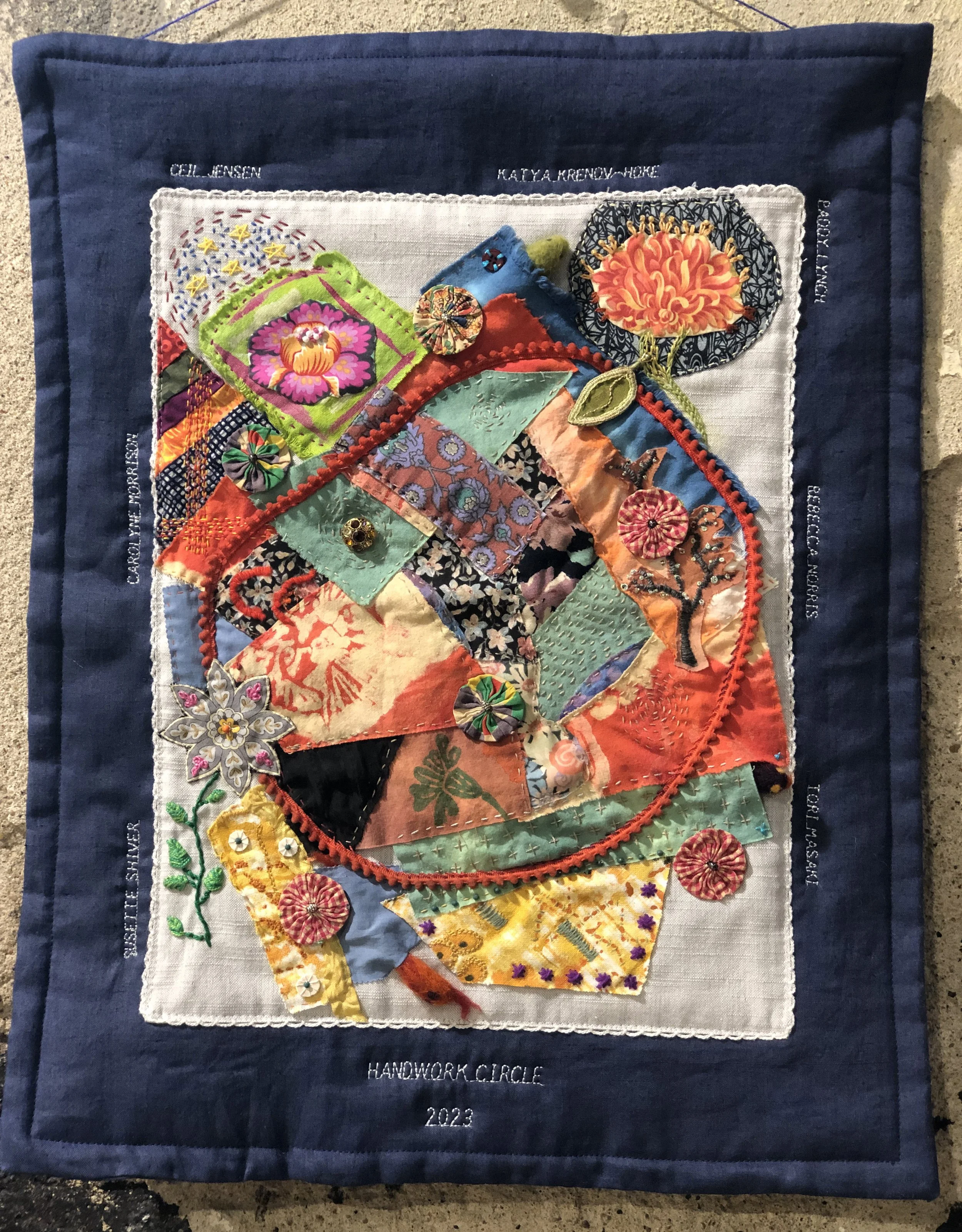
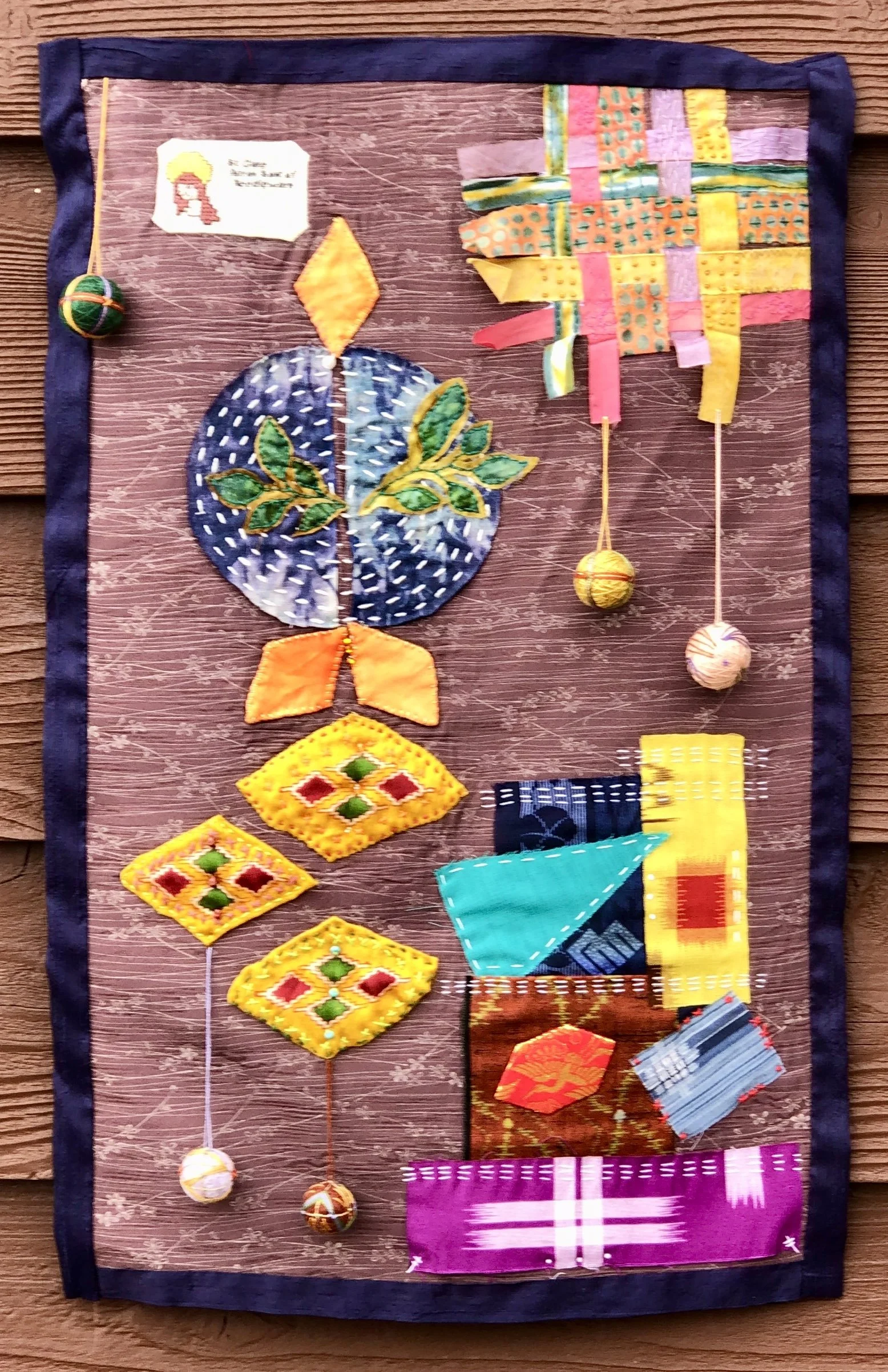
We are working on a 3rd collaborative project now. However, for review, I present the first two projects: Project #1 was lost to Helene and mud, but recovered; project #2 was never recovered.

Project #1. Susette Shiver, Carolyne Morrison, Ceil Jensen, Katya Krenov-Hoke, Paddy Lynch, Rebecca Norris, Tori Masaki, Silk, cotton, felted wool, miscellaneous items.

Project #1

Project # 2 Tori Masaki, Susette Shiver, Katya Krenov-Hoke, Paddy Lynch, Ceil Jensen, Rebecca Norris, Mary Kelley. Japanese kimono fabrics, sashiko, silk, cotton, Temari balls.

Project #2

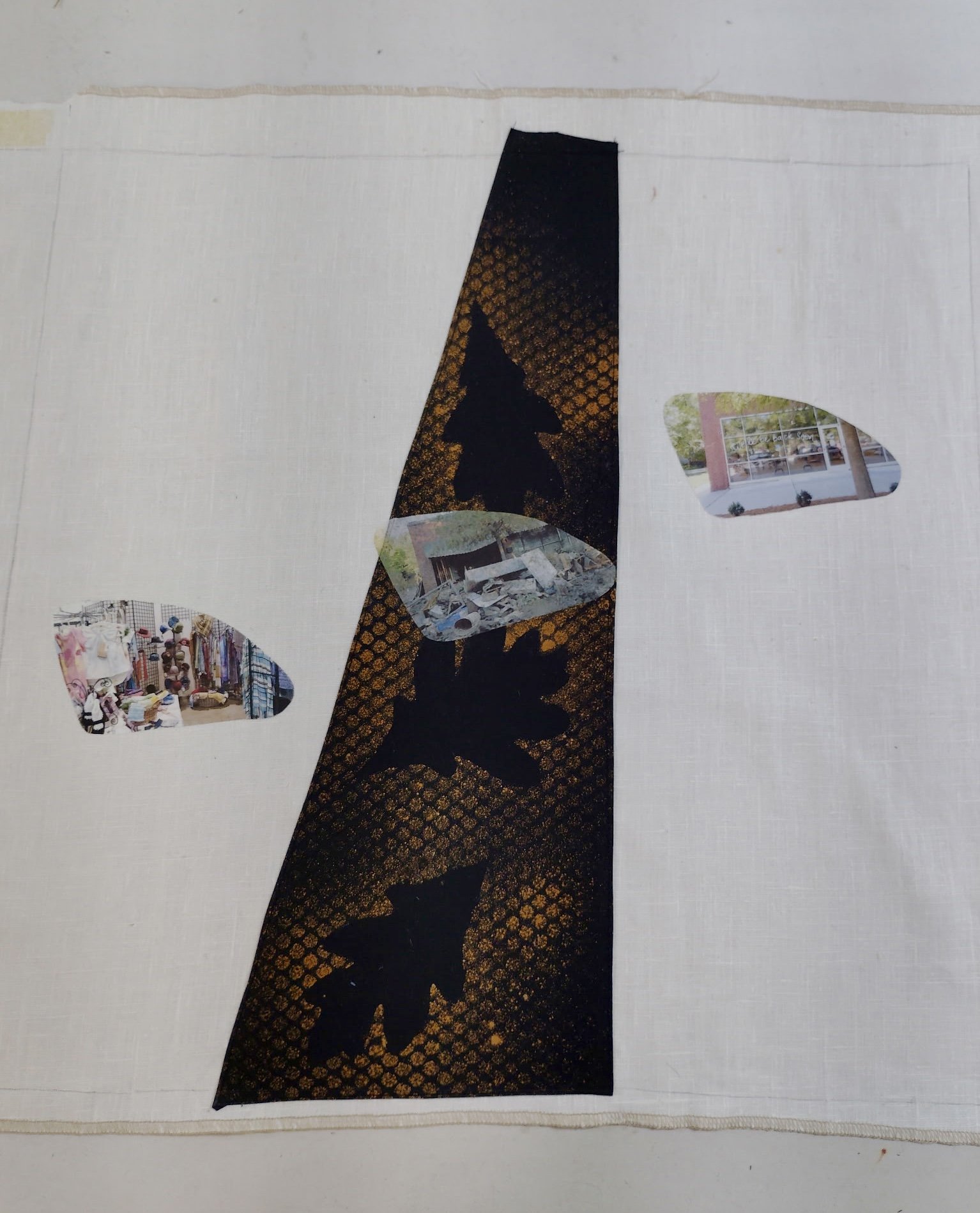
Kathleen Lewis started the next project and we choose a theme from our experiences at Local Cloth of from the Helene hurricane of 2024: before, just after/during, and after.

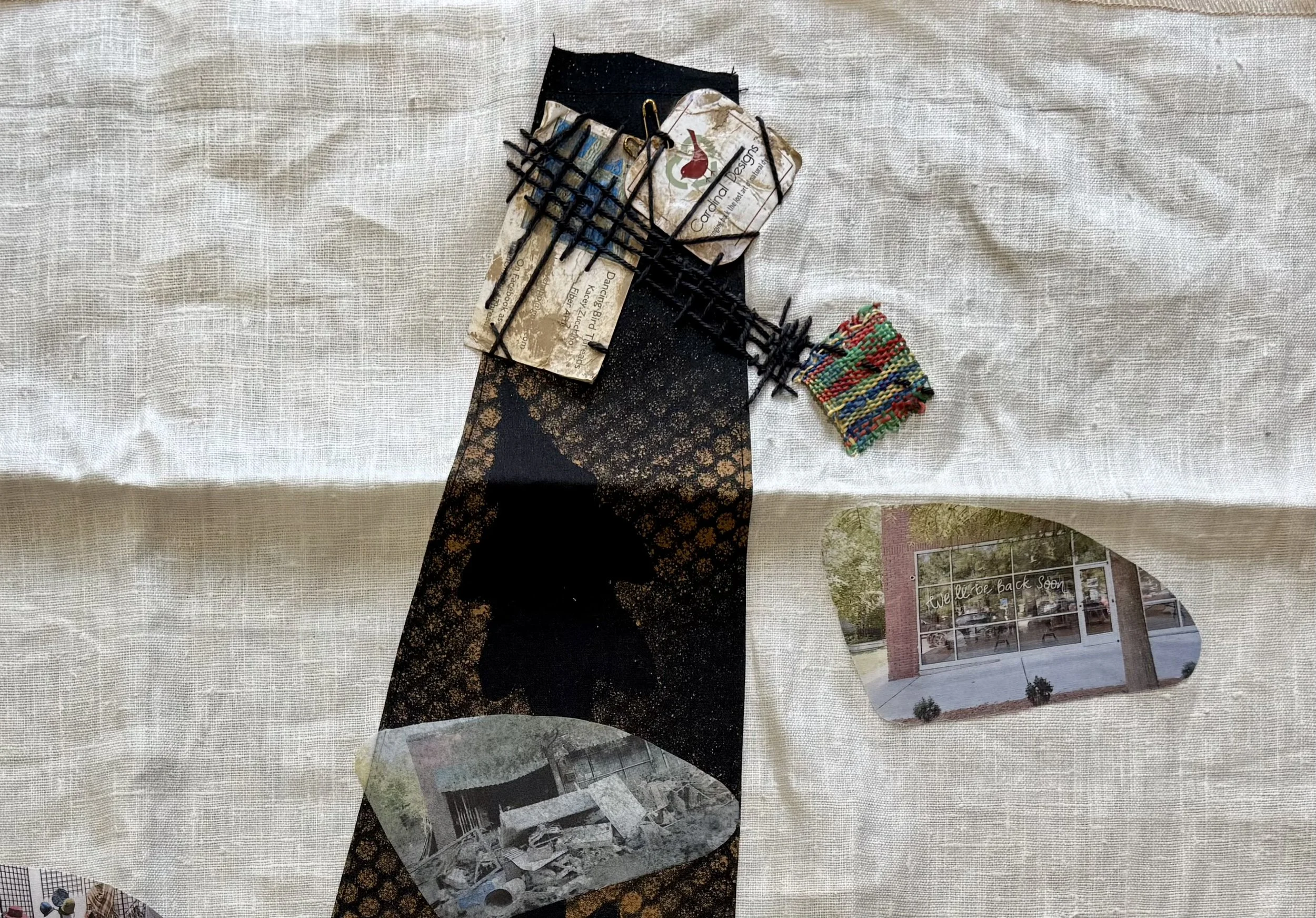
Kathleen Lewis passed this project beginning to Martha Brandon. cotton, photo-transfer to fabric images.

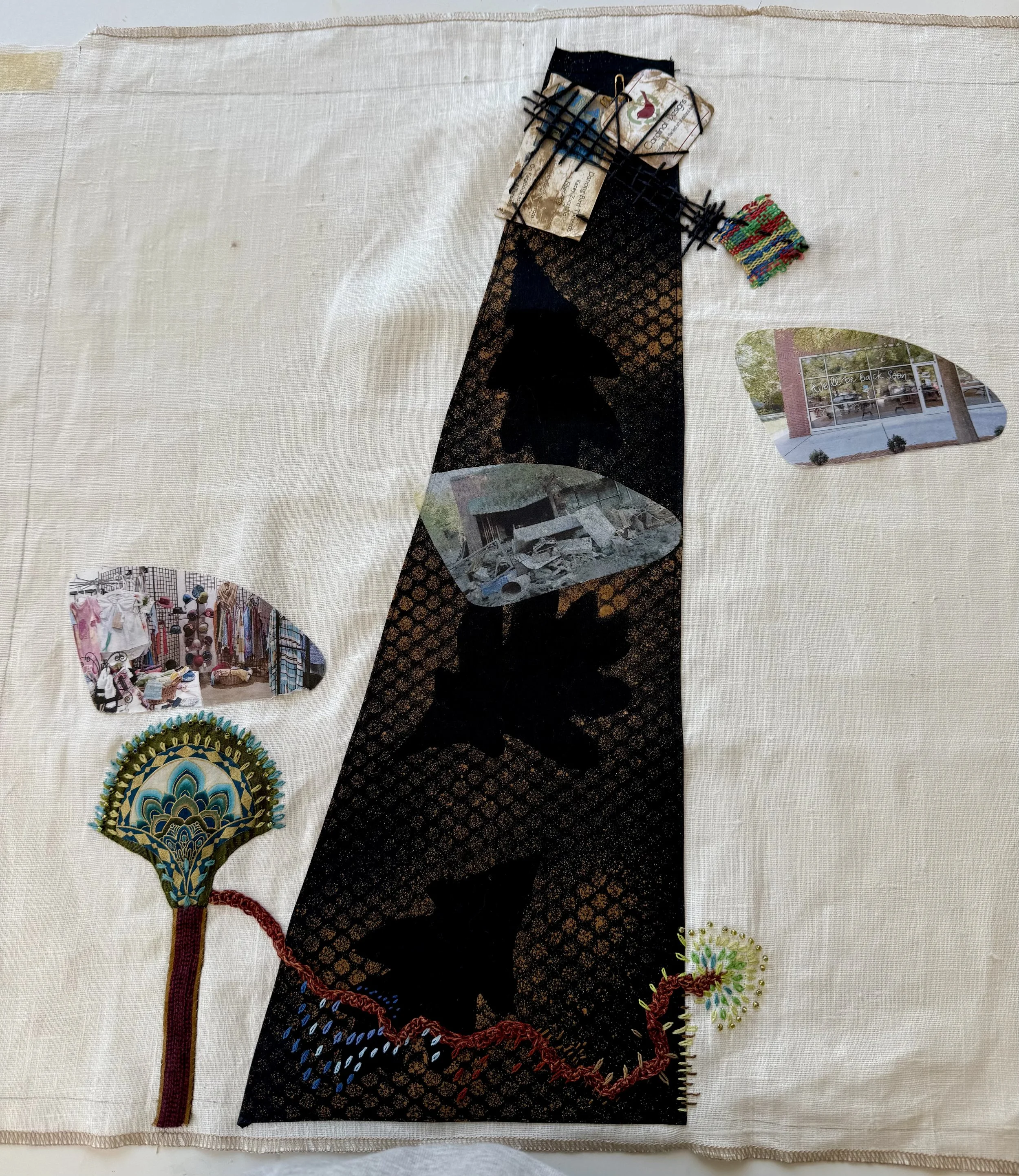
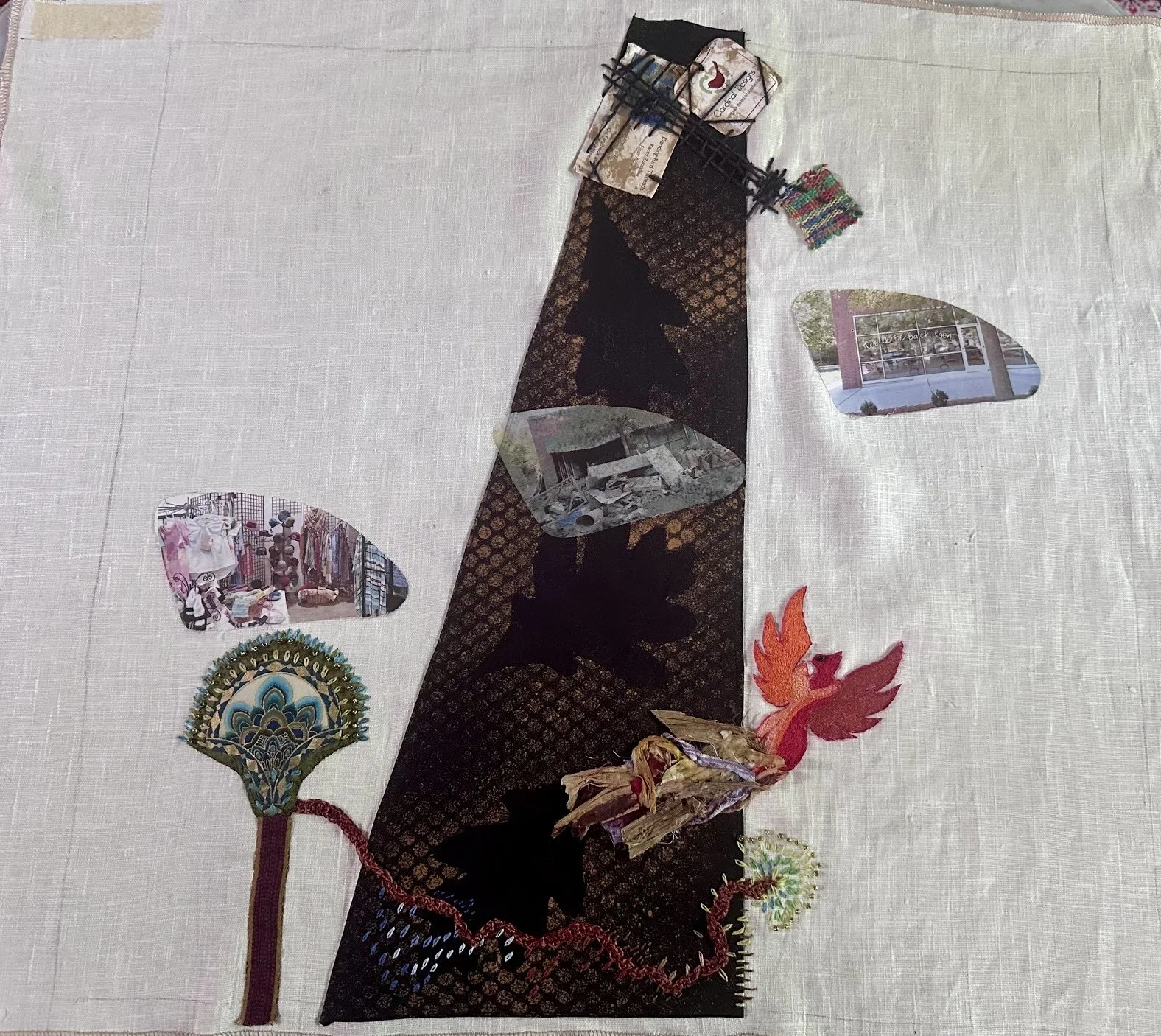
Kathleen Lewis started the project by creating a linen background with photos transferred onto fabric and a dark-colored center.

Martha Brandon had to think awhile about what her contribution might be, but she followed Kathleen Lewis’s beginning brilliantly.

Martha Brandon’s contribution centered on the top of the piece: cards from Local Cloth vendors who lost inventory during Hurricane Helene, along with elements of thread, weaving, surface design, and photo transfer.

List of participants:

1 Kathleen Lewis done

2 Martha Brandon done

4 Katya Krenov-Hoke done

5 Tina Hvitfeldt done

6 Ceil Jensen working on project

7 Judi Jetson

8 Linda Hayward

9 Rebecca Norris

10 Susette Shiver

I’ll keep you all posted!

Katya Krenov-Hoke added the tree and then the fallen tree. This reflected an event she and her husband endured when the tree fell on their house. When the house was built, they had carefully preserved the beautiful tree, only to have it topple over a few years later during the heavy rains and hurricane winds.

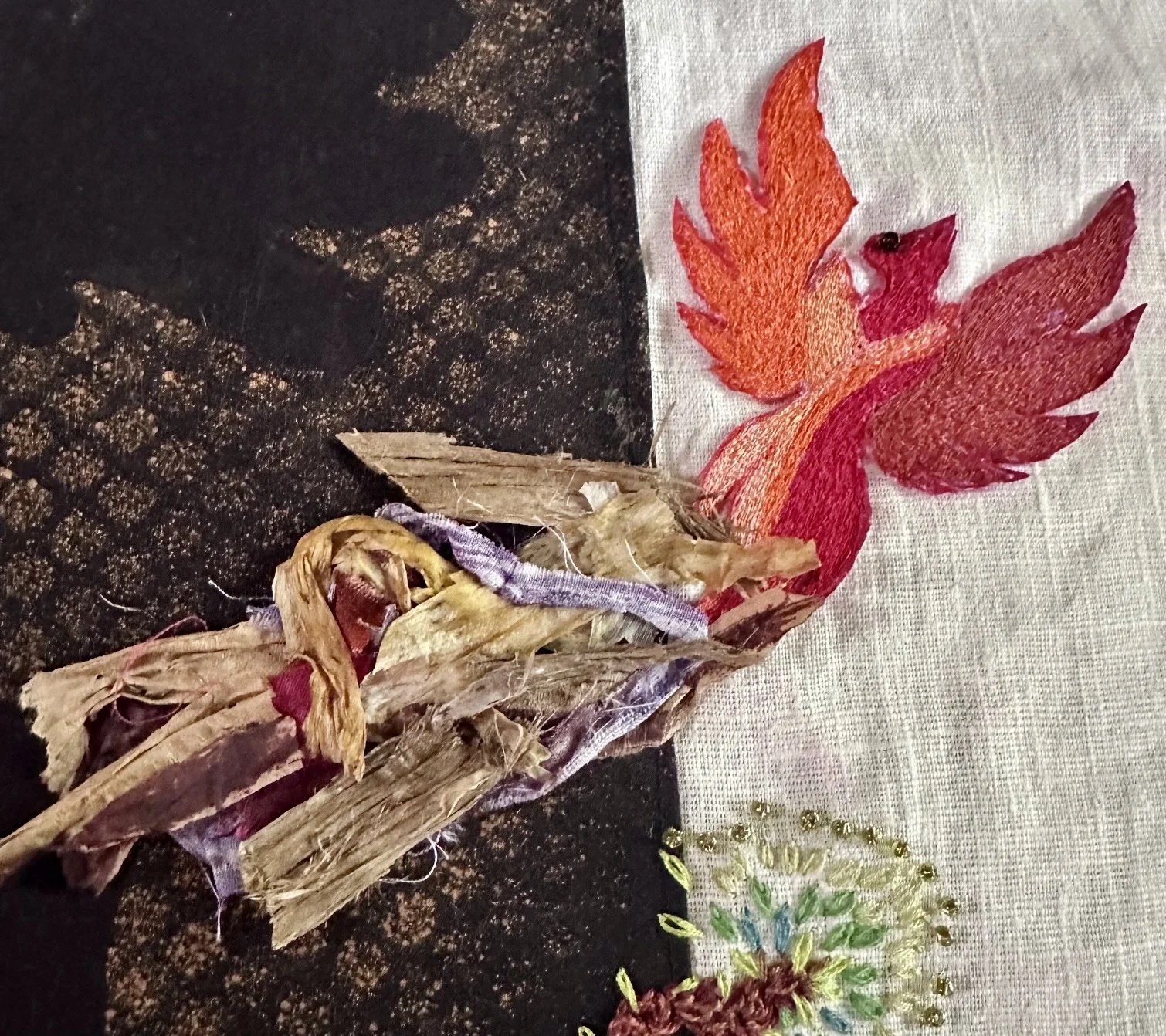
Christina Hvitfeldt’s contribution was a phoenix rising out of the oval cloth rubble.

Spinning Study Group at Local Cloth 2020

List of fibers and their sources

(information as of 2-3-2021)

Local Cloth Spinning Study Group Blog

Fiber farmers in the WNC Local Cloth Area

List of Fiber Samples for Spinning Study Group

Sept 21, 2020

AlpacaLast Penny Farm

MohairGood Fibrations

MontadaleWindy Wool Windings

Shetland, a farm in Henderson County

Oct 20, 2020

Blue Ridge Mountains Blend #1,  Local Cloth (30% Montadale, 25% Shetland, 25% Alpaca, 20% Mohair)

Blue Ridge Fine #1, Local Cloth (60% Montadale, 40% Alpaca)

JacobHobbyknob Farm

LincolnHobbyknob Farm

Nov 20, 2020

Romeldale, CVM Windy Wool Windings

Tunis, Wellspring Farm, Yancey Co, NC

3/4 Blue Faced Leicester x 1/4 Leicester Longwool (first shear), Love Handle Farm, Alexander, NC

3/4 Cormo x 1/4 Corriedale, Martha Owen Woolens

Dec 28, 2020

Dorset, Brian Grimm, Blackberry Ridge, Southwest VA

Icelandic, Katie Gaddy, Hidaway Farm 

Cormo top, Sebette Hamil, Leicester, NC

Romney, Barnardsville 2019

Jan 26, 2021

TeeswaterDry Creek Naturals, Taylorsville, GA

Llama, Peace of Eden Farm, Madison, NC

MerinoKhakalaki Farm, Trenton, SC

Black ShetlandSourwood Fiber Farm, Scott Spell, Fletcher, NC


I have mentioned Local Cloth, an Asheville fiber group supporting artists and farmers, in a previous blog (Nov 20, 2020). Local Cloth just sent out a member survey with questions particular to this past covid year. One of the questions was “Did you acquire any new hobbies this year?” My enthusiastic answer was blogging and hand spinning wool (double exclamation points, smiley face)!

I have always loved anything to do with wool and knitting. I sometimes become bored so I tend to switch projects and work in parallel on 3-4 projects. I also take workshops (from Local Cloth) or learn by videos or books. I often lack patience to follow complicated patterns, however I love to design and make things to my specifications and preferences. Since a teenager, I have tried to make many kinds of things, but a lasting interest is working with wool. I think I speak for other knitters when I say that a display or basket full of beautiful yarns makes my heart race; I rush over to look and feel. Visual and tactile pleasures—please drag me out of the shop! Hence, the famous stashes so many of us create.

I am a newbie at spinning. After a lesson and some internet learning, I jumped in at the deep end by joining Local Cloth’s Spinning Study Group last fall. This is an opportunity to be around experienced spinners and fiber farmers (virtually on Zoom at present), to experience and learn about spinning fibers obtained from different sheep breeds and local farmers, and to enjoy spinning in the company of others. Judi Jetson gave me my first (socially distanced, outdoors) spinning lesson at her home in Weaverville. Judi, the driving force behind the creation and development of Local Cloth and the current president, is very generous with her time and talents. By the way, I’ll trade ya—something I made for something you made or taught me! Contact me!!

During the Spinning Study Group sessions, we look up only occasionally at the computer screen while spinning. I learned from leading Local Cloth’s Virtual-Handwork Circle that my screen grabs are much better when I say to the group “Look up and smile”! (Photo 1). Spinners like to spin together indoors or outdoors, at your house or mine. Spinning alone indoors on a rainy day is also wonderful. In the spinning study group, each 2 hour monthly session involves spinning, discussing, and characterizing four different yarns from local farmers. To see my photos of the fibers before spinning check out the Local Cloth blog by clicking Learn More. To see how my yarns look and how they knit up, stay tuned!

Photo 1. Spinning Study participants on 12-28-2020.

Photo 1. Spinning Study participants on 12-28-2020.