Local Cloth Waterline Project

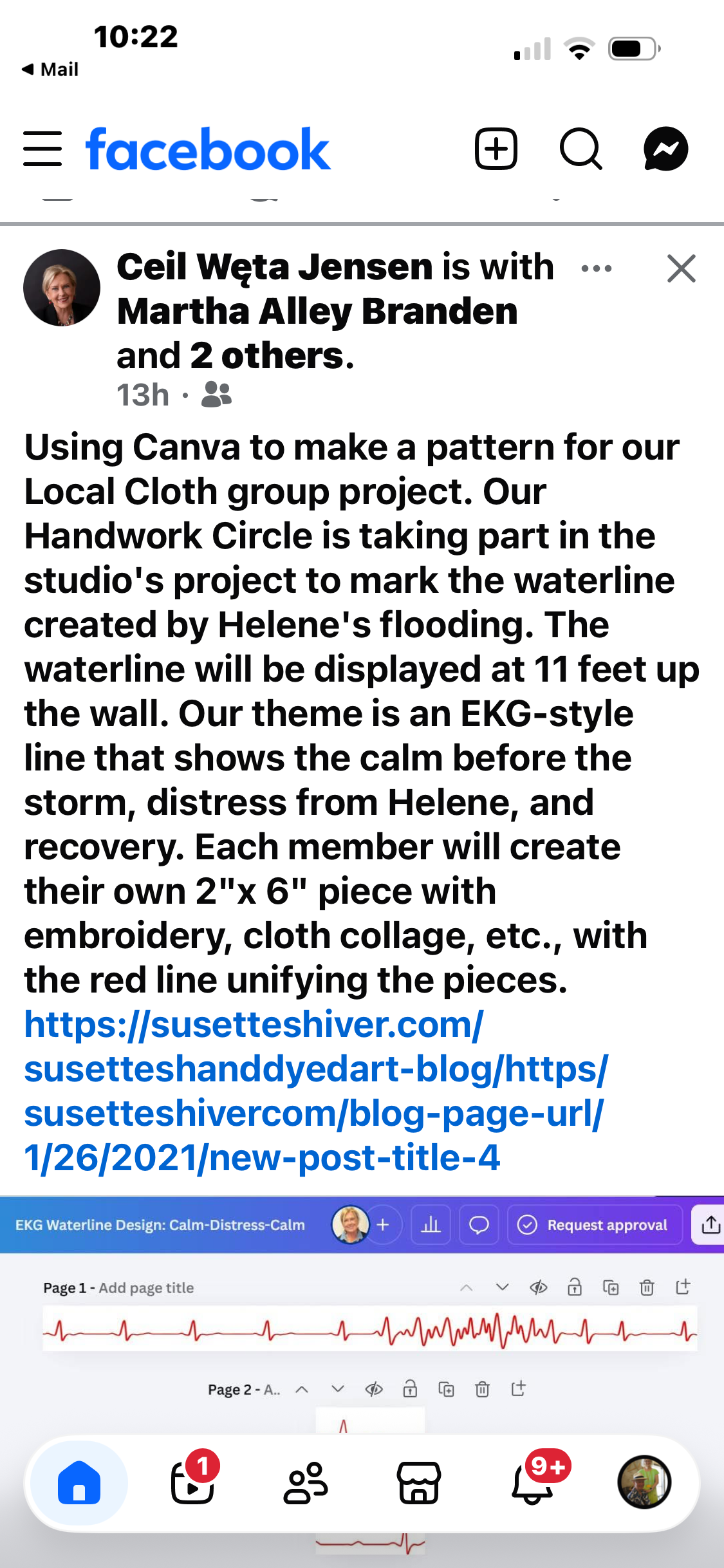
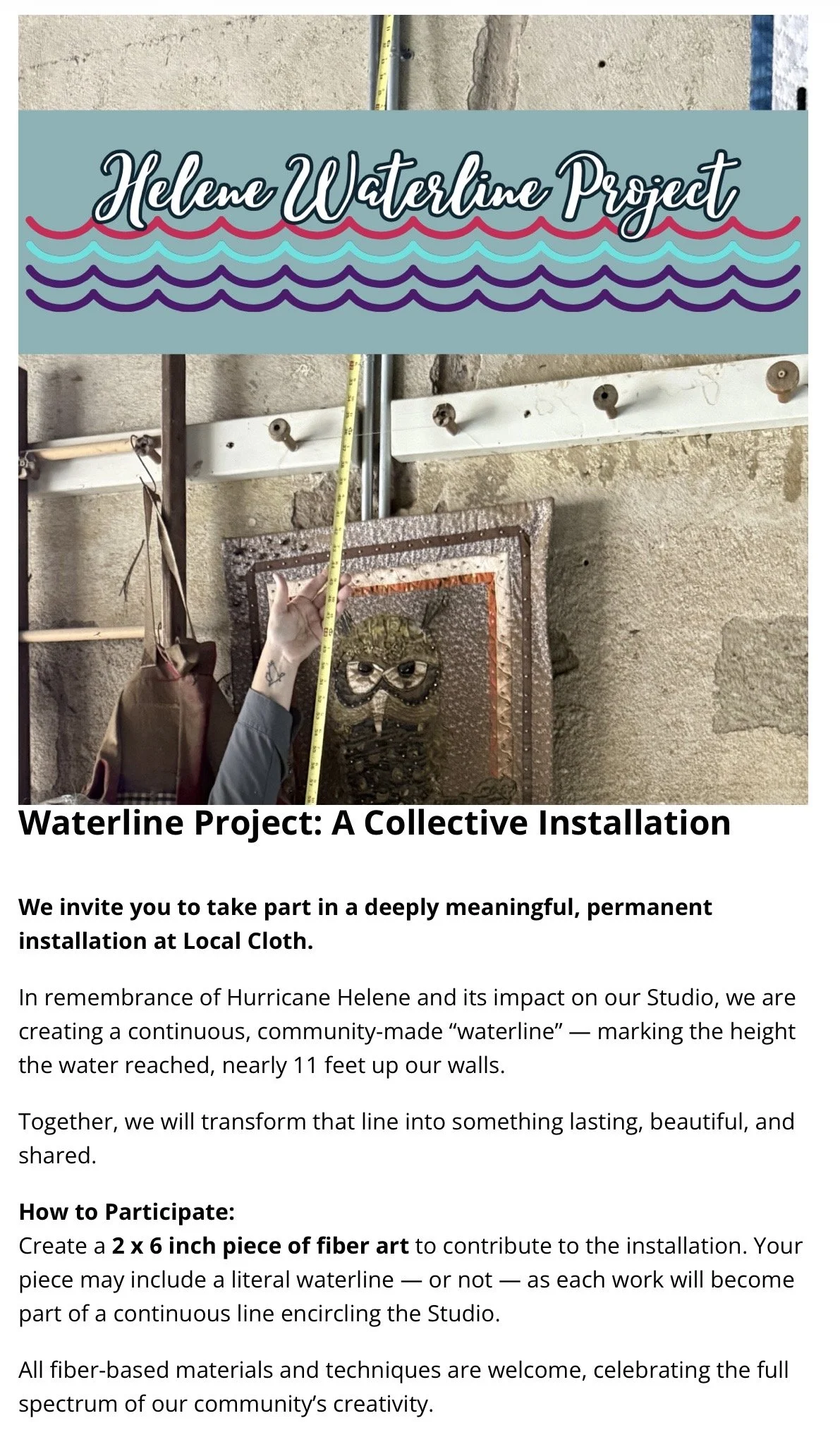
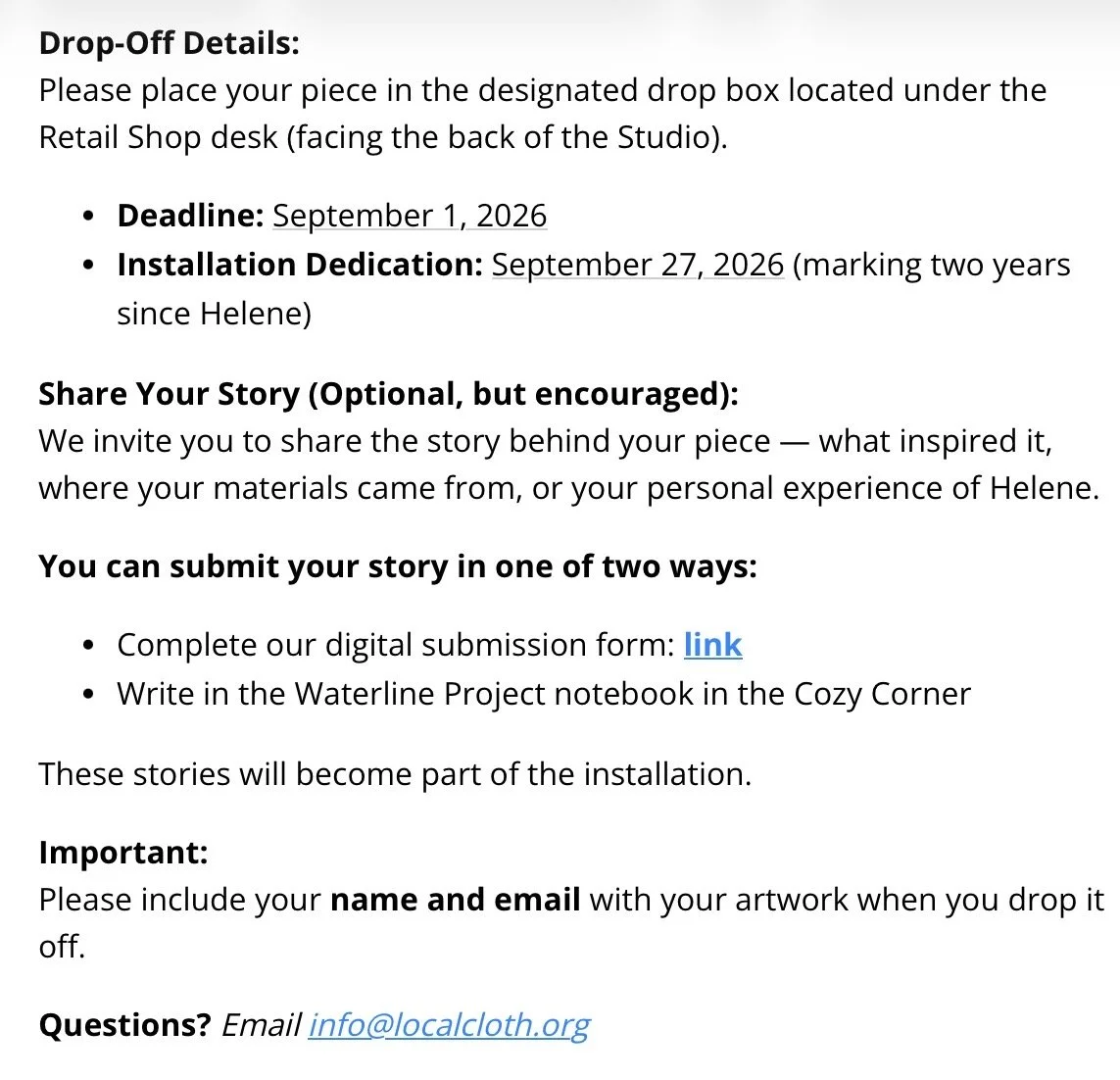
The details of the Post-Hurricane Helene member project were sent to Local Cloth members in an email. I captured this information in the screenshots below.

Our Handwork Circle at Local Cloth decided to approach this as a group. We discussed it during our online Zoom gathering today. We volunteered several ideas and identified felt as a possible medium. Several of us have nice collections of felt in different colors.

At the bottom of each 2” × 6” piece, we felt that browns would be especially relevant to the project. The water that filled our studio in the wake of Hurricane Helene was filled with brown sludge from the French Broad River. Above the sludge-colored water in our pieces, however, colorful objects — including flowers and other scenes along Depot Street — might provide a brighter aspect that mirrors our recovery. That is where we are thus far.

The pieces must be delivered by September 1, 2026, so that is our deadline. Since this is a group project, we want to link our 2” × 6” pieces together in a chain and submit them that way.

There are two ways to submit:

  1. Enter it in the Waterline project book in Local Cloth’s cozy corner.

  2. Submit it online:

Waterline Project Submission Form


Update — May 2, 2026, on the Handwork Circle’s Planned Contributions

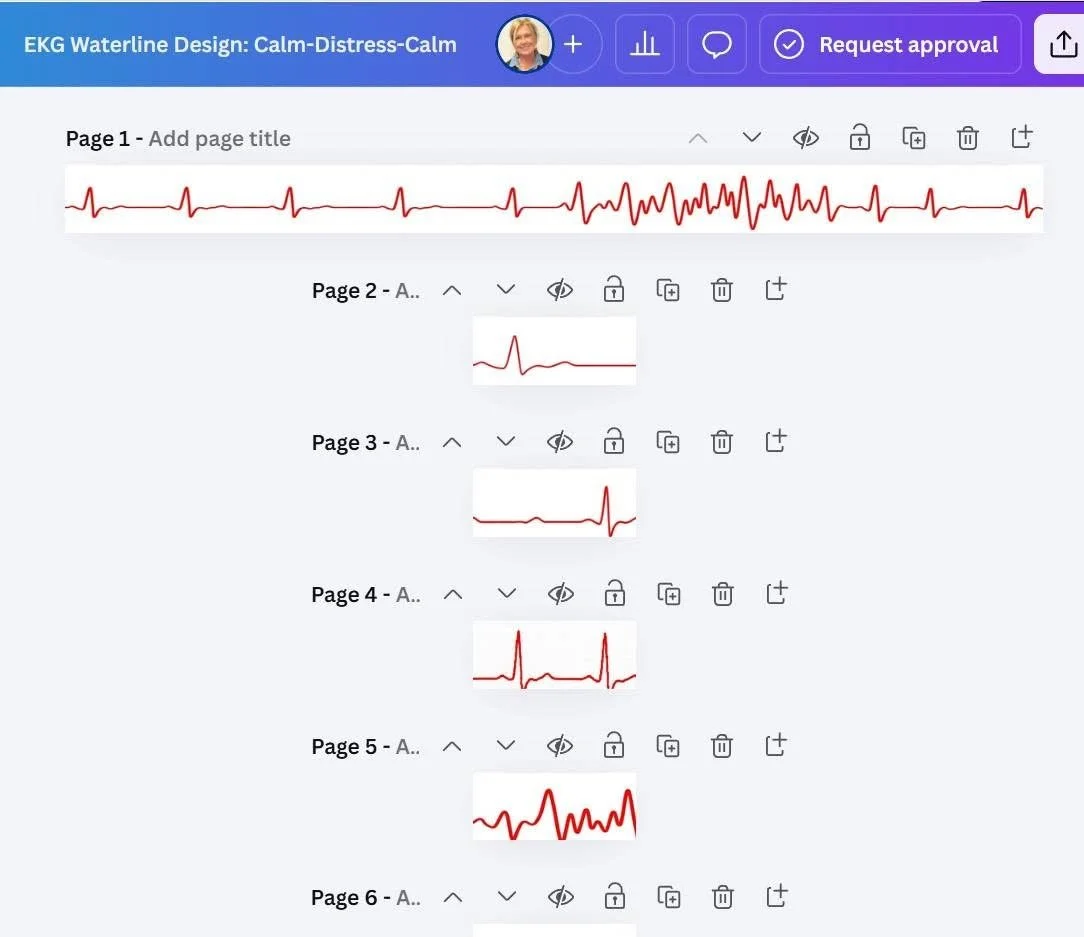
The Handwork Circle contribution, we decided, will consist of joined individual pieces unified by a heartbeat motif: the tracing of a heart monitor. We discussed ideas for designing the 2” × 6” strips that will be arranged horizontally 11 feet up the wall. The earlier idea of requiring brown and other shared colors for everyone to use was ultimately discarded.

We were inspired by the Tapestry Interest Group’s installation at the Local Cloth Studio.

Chatting with Susan Gaire About the Tapestry Interest Group at Local Cloth

Ceil volunteered to create and distribute paper templates after designing the heartbeat line digitally. At present, we feel participants should have the freedom to choose their own colors, with one proviso: the contrast between the heartbeat line and the background must remain strong.

Because we are also working on Collaborative Project #3, whose theme is before, during, and after Hurricane Helene, the heartbeat trace will progress from normal rhythm, to fibrillation, and then gradually recover to normal again.

I will send out a request for participation to everyone who has attended the Handwork Circle during the past year to ensure that all who wish to be involved are informed.


Ceil’s work:


Handwork Circle: Project #3

We are working on a 3rd collaborative project now. However, for review, I present the first two projects: Project #1 was lost to Helene and mud, but recovered; project #2 was never recovered.

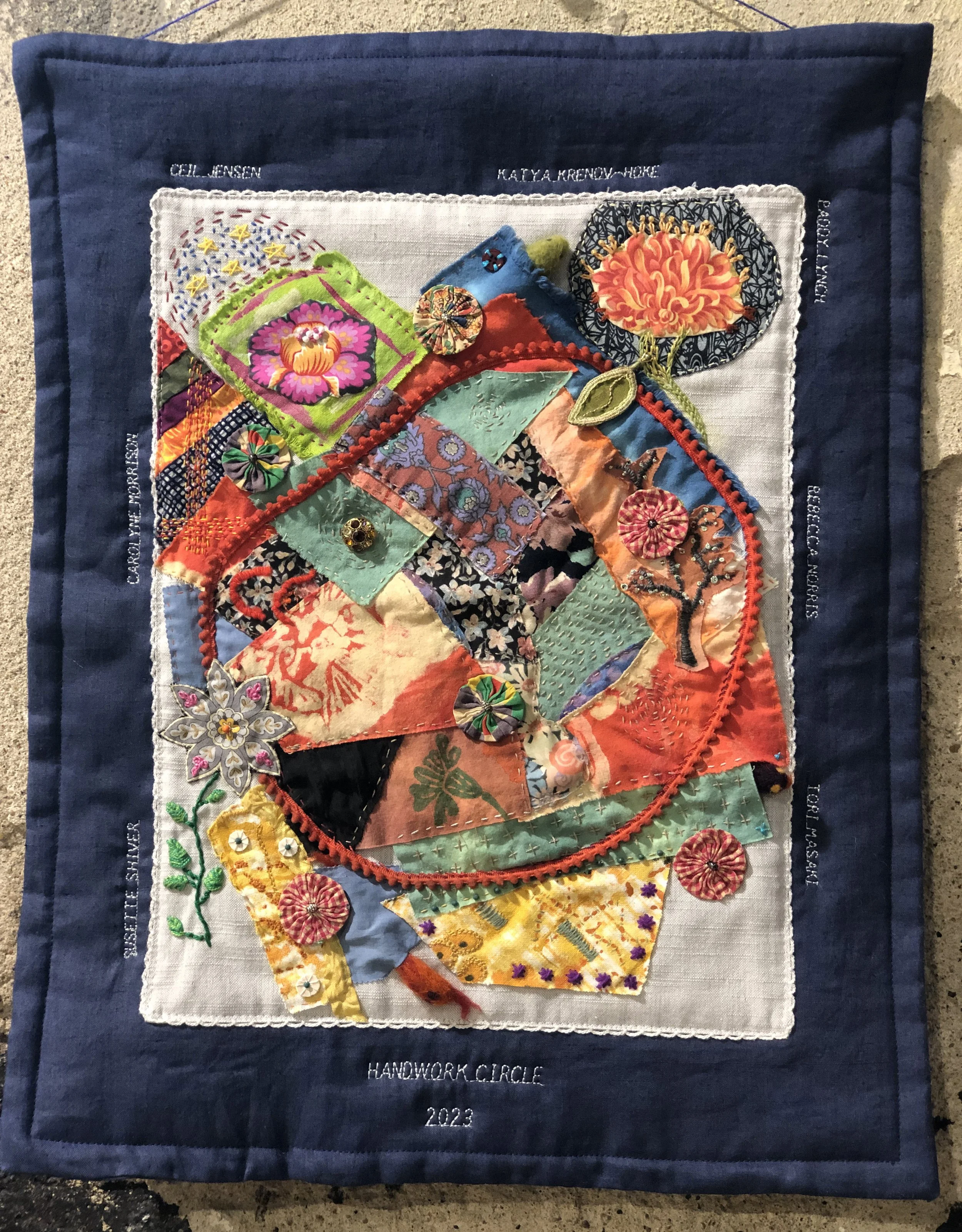
Project #1. Susette Shiver, Carolyne Morrison, Ceil Jensen, Katya Krenov-Hoke, Paddy Lynch, Rebecca Norris, Tori Masaki, Silk, cotton, felted wool, miscellaneous items.

Project #1

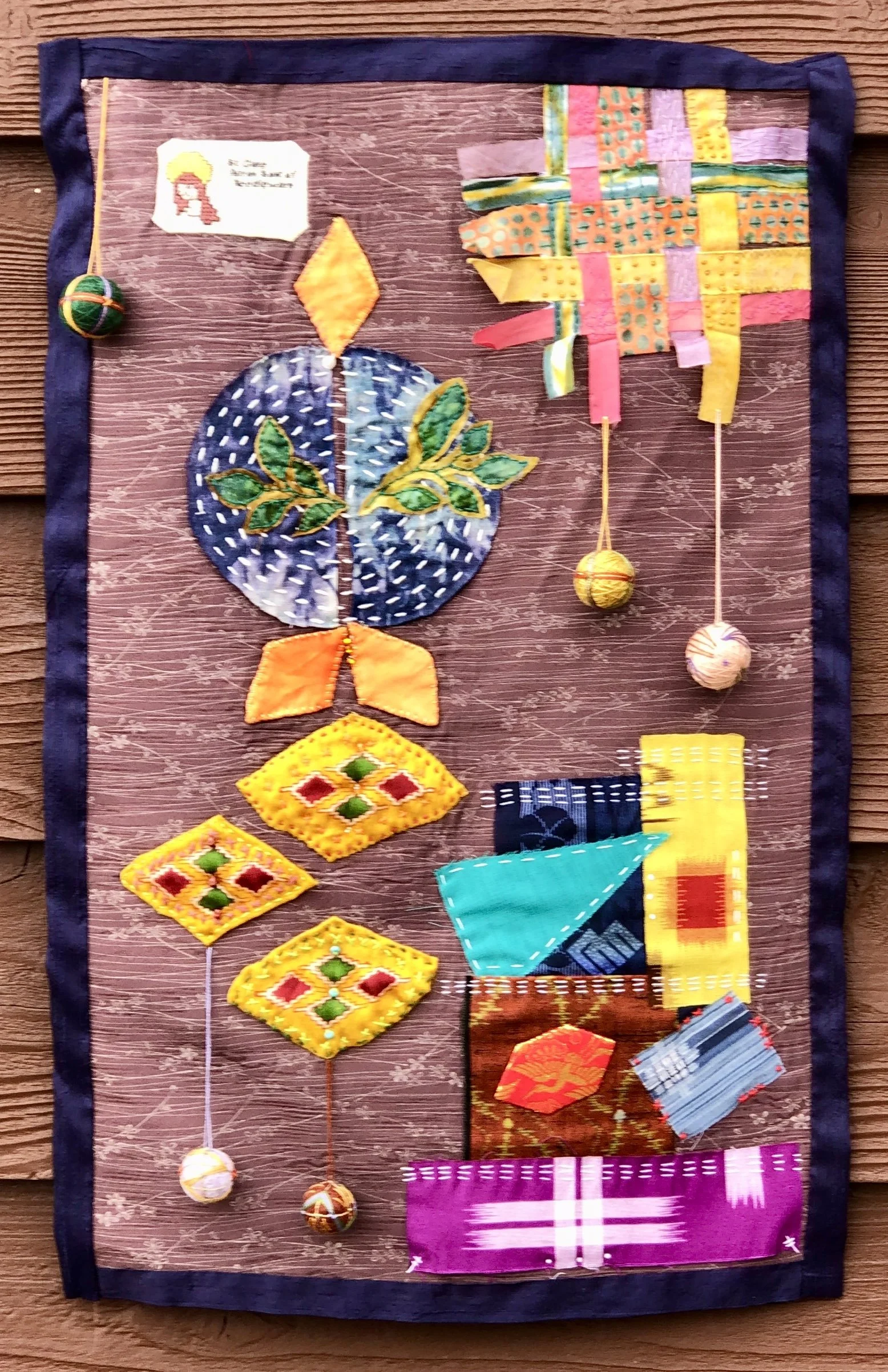
Project # 2 Tori Masaki, Susette Shiver, Katya Krenov-Hoke, Paddy Lynch, Ceil Jensen, Rebecca Norris, Mary Kelley. Japanese kimono fabrics, sashiko, silk, cotton, Temari balls.

Project #2

Kathleen Lewis started the next project and we choose a theme from our experiences at Local Cloth of from the Helene hurricane of 2024: before, just after/during, and after.

Kathleen Lewis passed this project beginning to Martha Brandon. cotton, photo-transfer to fabric images.

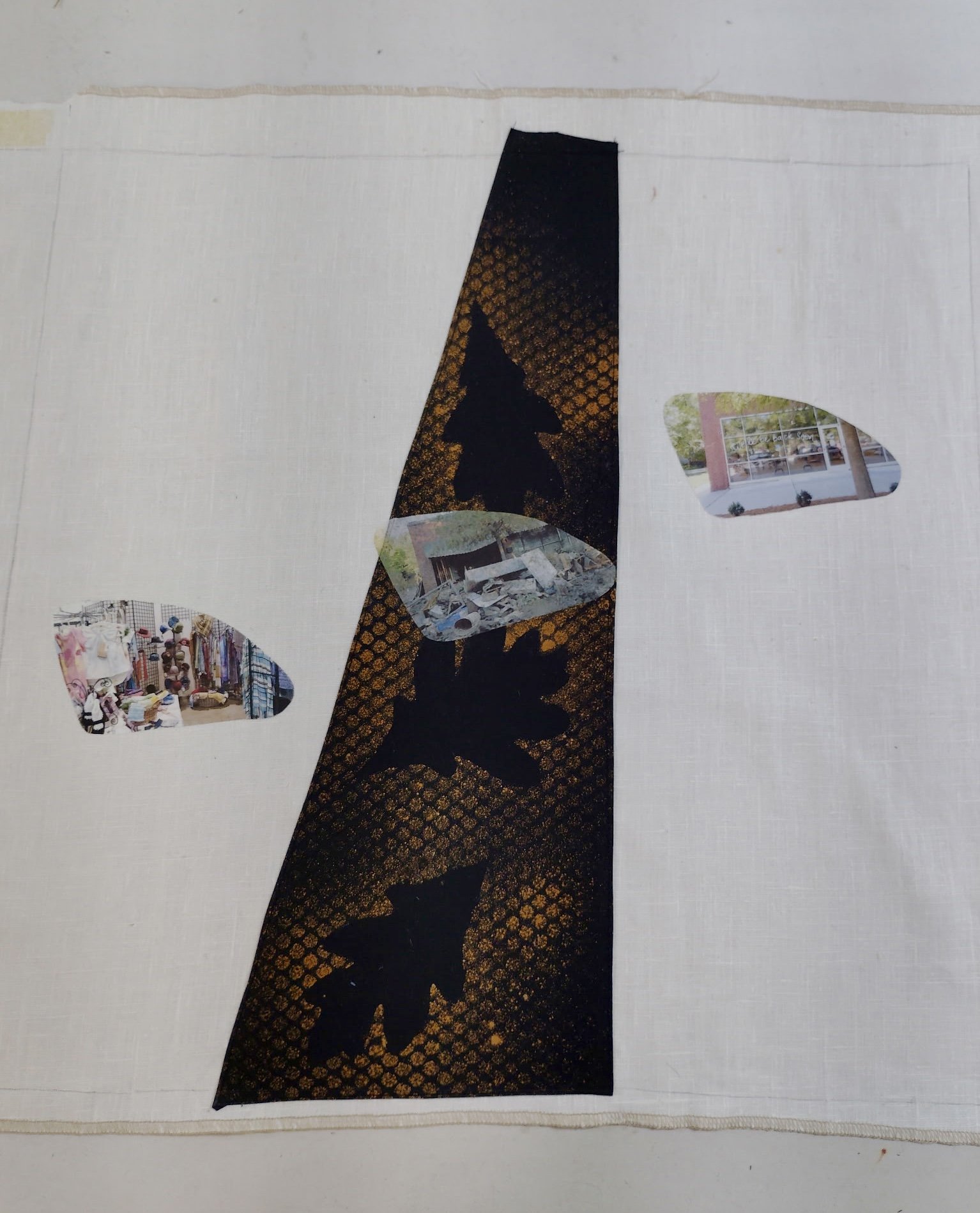
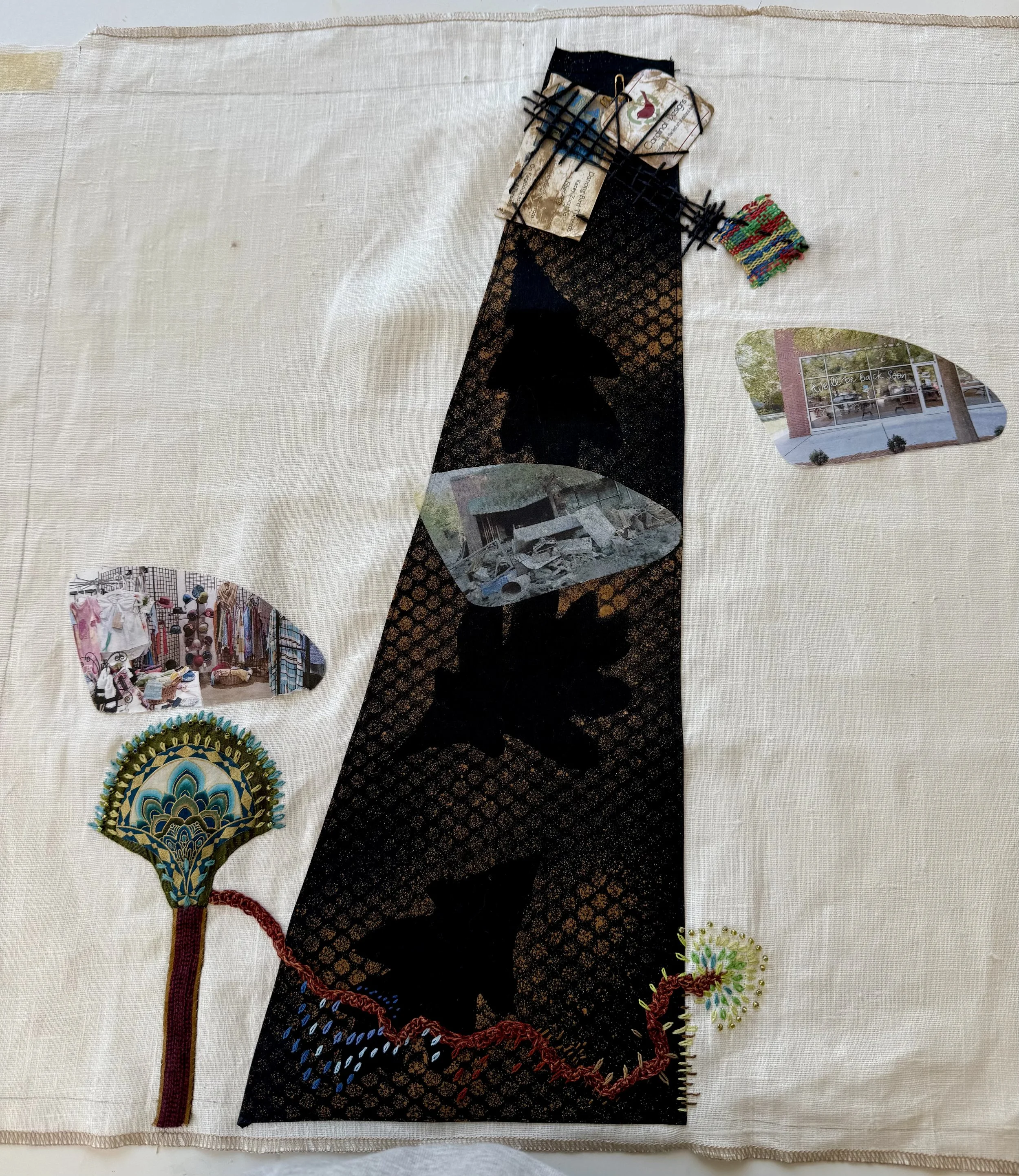
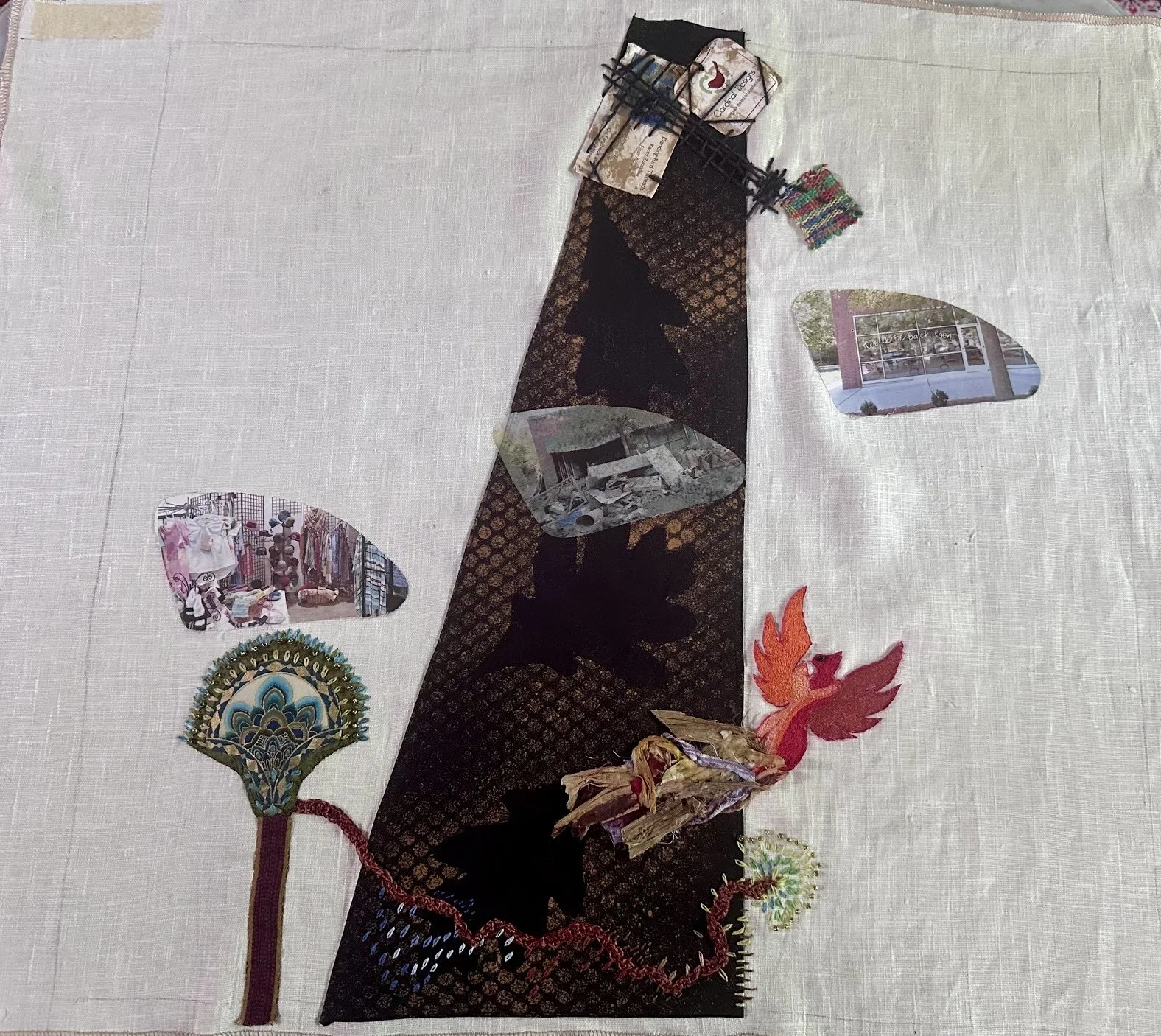
Kathleen Lewis started the project by creating a linen background with photos transferred onto fabric and a dark-colored center.

Martha Brandon had to think awhile about what her contribution might be, but she followed Kathleen Lewis’s beginning brilliantly.

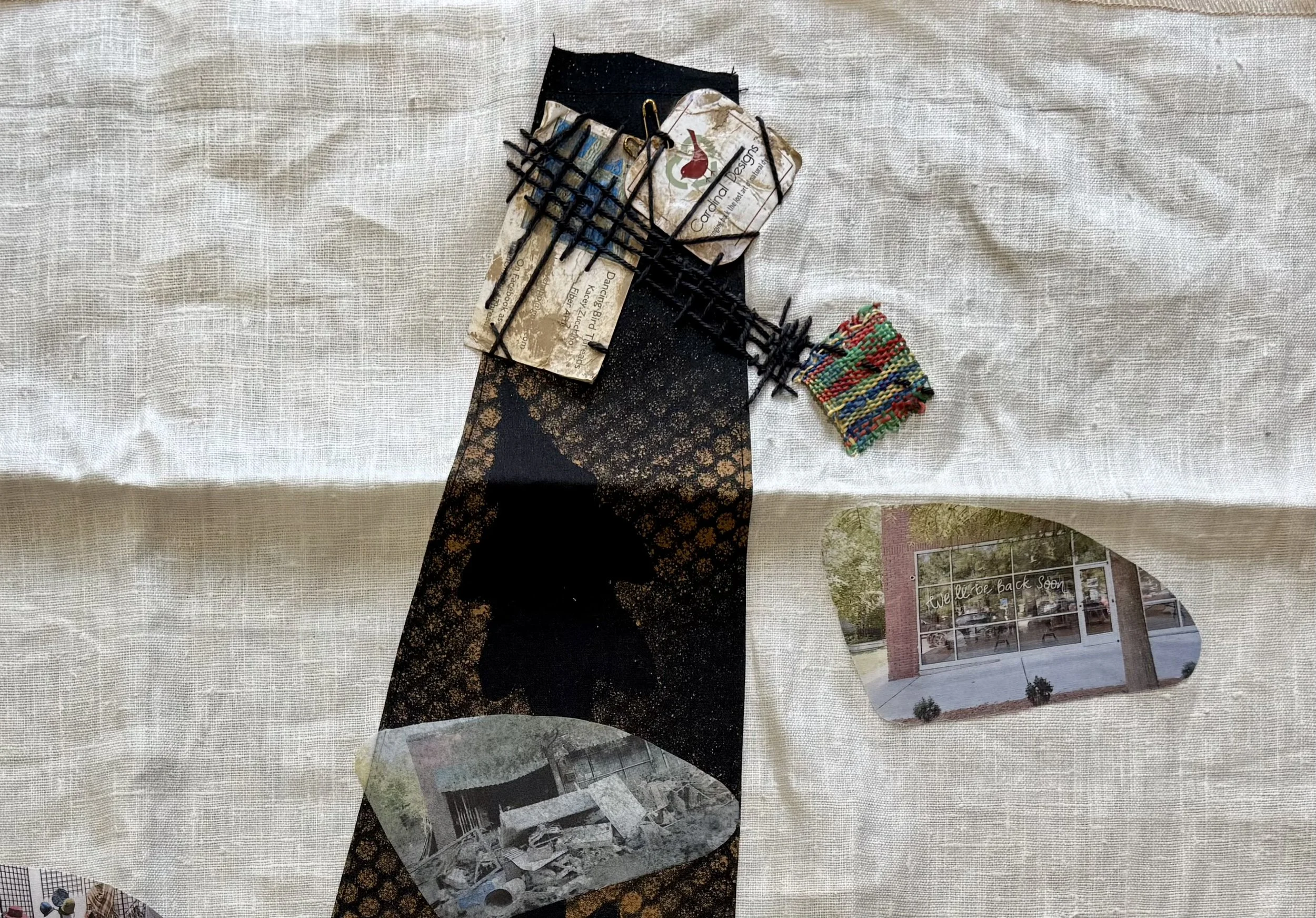
Martha Brandon’s contribution centered on the top of the piece: cards from Local Cloth vendors who lost inventory during Hurricane Helene, along with elements of thread, weaving, surface design, and photo transfer.

List of participants:

1 Kathleen Lewis done

2 Martha Brandon done

4 Katya Krenov-Hoke done

5 Tina Hvitfeldt done

6 Ceil Jensen working on project

7 Judi Jetson

8 Linda Hayward

9 Rebecca Norris

10 Susette Shiver

I’ll keep you all posted!

Katya Krenov-Hoke added the tree and then the fallen tree. This reflected an event she and her husband endured when the tree fell on their house. When the house was built, they had carefully preserved the beautiful tree, only to have it topple over a few years later during the heavy rains and hurricane winds.

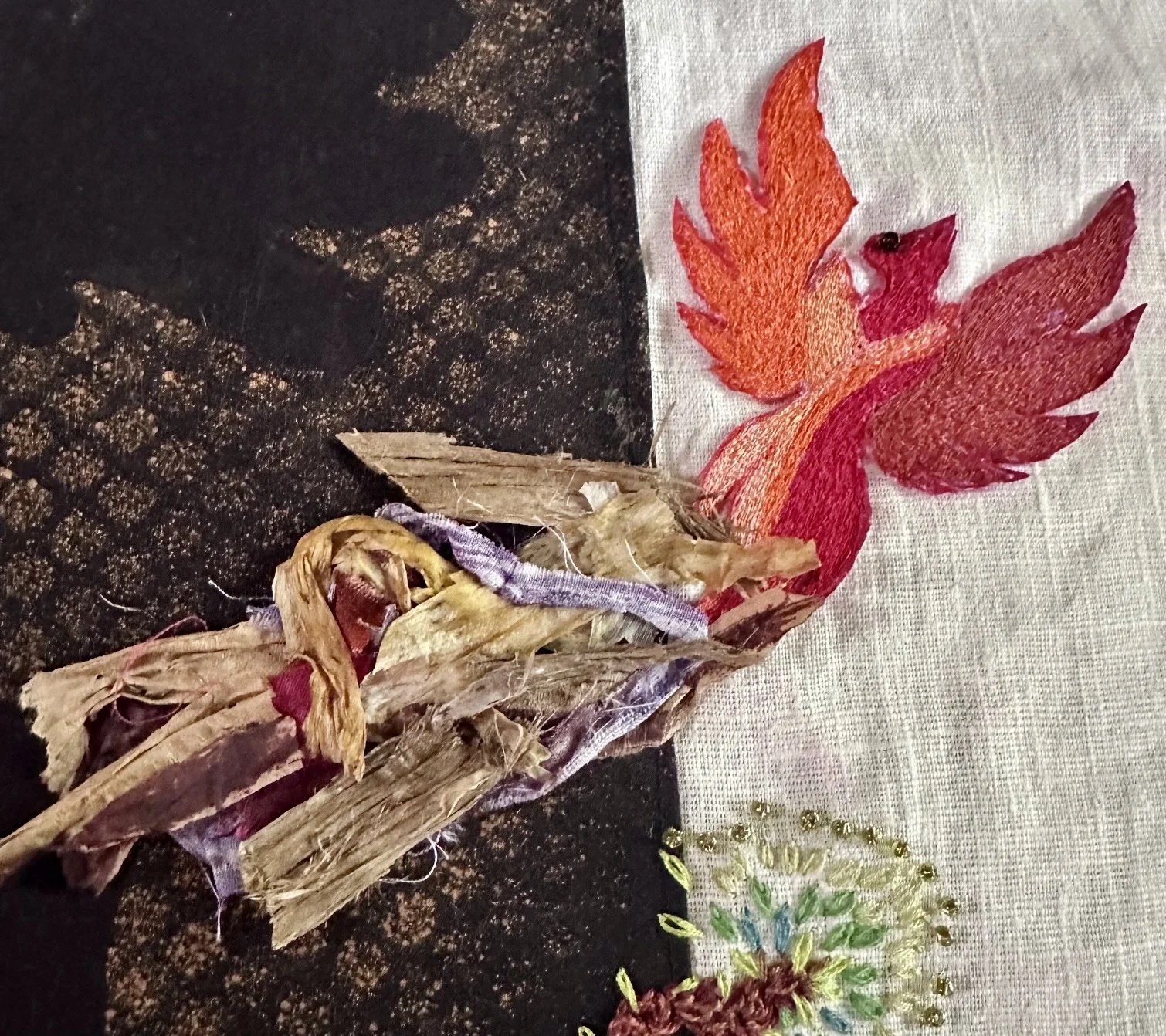
Christina Hvitfeldt’s contribution was a phoenix rising out of the oval cloth rubble.

Learning to spin wool

I have found that even though I have many interests such as knitting, dyeing wool yarn, dyeing cottons and linens, quilting and making items for home and sale, I have always thought (romantically!!!) about spinning wool. One of the lists of how to avoid depression while staying at home during covid-19 is to learn a new thing. Well, I am happy to report it works! The process of learning how to spin has sparked my interest, imagination, and creativity for all my activities. I am more cheerful. So, like knitting, spinning is therapeutic.

Last fall I bought a Baynes spinning wheel from Judi Jetson of Local Cloth. Judi seems to collect all kinds of equipment on her fiber journey, some of which she uses for teaching. This Baynes spinning wheel is no longer produced, but it is a great portable wheel one can bring along for outdoor spinning parties more than 6 feet apart! I really do look forward to the day I can trot down to the Local Cloth studio to meet in person with fellow spinners. The Baynes has Scotch tension plus two whorl sizes to regulate the speed of the wheel. Ian Baynes, who worked for Ashford with the re-emergence of interest in spinning in the 1960’s, developed his own spinning wheel in the 1970’s in New Zealand. A marvelous blog detailing the history of spinning wheels in New Zealand can be found here. The photograph below was reproduced from pacificwoolandfiber.com, a supplier of spinning wheels and looms.

Ian Baynes developed this spinning wheel in the 1970’s following a re-emergence of interest in spinning.

Ian Baynes developed this spinning wheel in the 1970’s following a re-emergence of interest in spinning.

Judi gave me an outdoor spinning lesson and some samples for practice and I was off and going. I started with a sample of Montedale from Windy Wool Windings from which I formed a two-ply using an unnamed (my bad) undyed wool. Since I didn’t know about Windings Per Inch (WPI) and Twists Per Inch (TPI) and such, I failed to record any significant details of what I had done besides the fact that I hand carded and made rolags to spin.

So, practice practice practice and now I had to learn a bit about finishing yarn and knitted pieces. Never, or almost never, in my knitting world had I bothered to block finished pieces, and initially spinning wool I skipped it. I am now learning what the benefits are! And, Judi admonishes me, always finish yarn after spinning. I learned another tidbit the hard way; if there is too much grease in the yarn, it will be hard to spin and hard to separate out bits of yucky stuff. Soon I will know all the words to describe yucky stuff, but suffice it to say, I have learned to pre-wash small portions of fleece or fiber that arrives too sticky.

I have settled on a washing and finishing standard. That is to say, I have a method that seems to work that may be modified whenever I learn otherwise. The process of experimenting and learning from others allows a progression with continuous improvement. In terms of science, scientific hypothesis-generation and experimentation leads along a path of discovery. There is no absolute truth in each conclusion. Science never stands still. It is about a consensus that is continually supplanted by input of new data collected using new methods. Any consensus is expanded upon by a competing array of scientists to move the conclusions forward toward relative truth. Most Americans are poorly educated in science and fail to realize this. And we all love to be a little fanciful. Ok in art? Ok in craft? Ok in science?? I think not.

Was that an “aside” or what!?

WASHING, FINISHING, BLOCKING

Step 1: Check for excess grease in raw samples, if present, soak fiber in hot water with a squirt of Ivory liquid soap for 1 h and then gently rinse 2-3X with cool water. (X=times)

Step 2: After spinning, repeat the wash: soak fiber in hot water with a squirt of Ivory liquid soap for 1 h and then gently rinse 2-3X with cool water. Gently thwap against side of deep sink 2X then orient the skein 180 degrees and thwap twice more. (Thwap-sling in a circular motion landing the length of the fiber skein along the side of the sink). Hang to dry.

Step 3: To finish the knitted item, either 1) steam iron the (dry) piece with cloth in between the piece and the iron, or 2) repeat step 2 without thwaping. Place between two towels and press the water out. Pin to keep in place. Results: The iron tends to flatten the piece whereas the soaking in hot, soapy water and drying flat (with or without pins) leads to a more natural look. In both cases, the fibers are set into place.

FIRST EFFORTS

In my last Susette’s Hand Dyed Art blog of November 20, 2020, I highlighted Local Cloth and the fiber farmers within the Local Cloth “Fibershed”, approximately 100 mile radius from Asheville. There, you can find the list of farmers that participated in the Fiber Farmers Day in September. When I went, I bought lots fiber to spin: Cormo, Cormo/Leceister Long Wool (LLW), LLW, Romney, and Shetland Tebo/Tete.

In my first efforts, spinning through finished product, I generated a hat and two headbands. These were made from Shetland Tebo/Tete wool from Sourwood Fiber Farm, knitted on size 8 needles, and dyed with indigo. Shetland is wonderfully springy!

I rummaged through the wool I have collected over the years when I had a vague notion of felting. I had bought a few things just because; it was so pretty. In those days, when I lived in Maryland, I was an avid attendee of the annual Maryland Wool and Sheep festival. So, now I have a small container with rabbit angora which I bought to appease my small son whom I had dragged to the festival with me! He could open the box and feel the softness. I have about 4 oz of dyed roving. After moving to North Carolina and attending Southeastern Animal Fiber Fair (SAFF), I have 3 bags full of merino in beautiful brown tones.

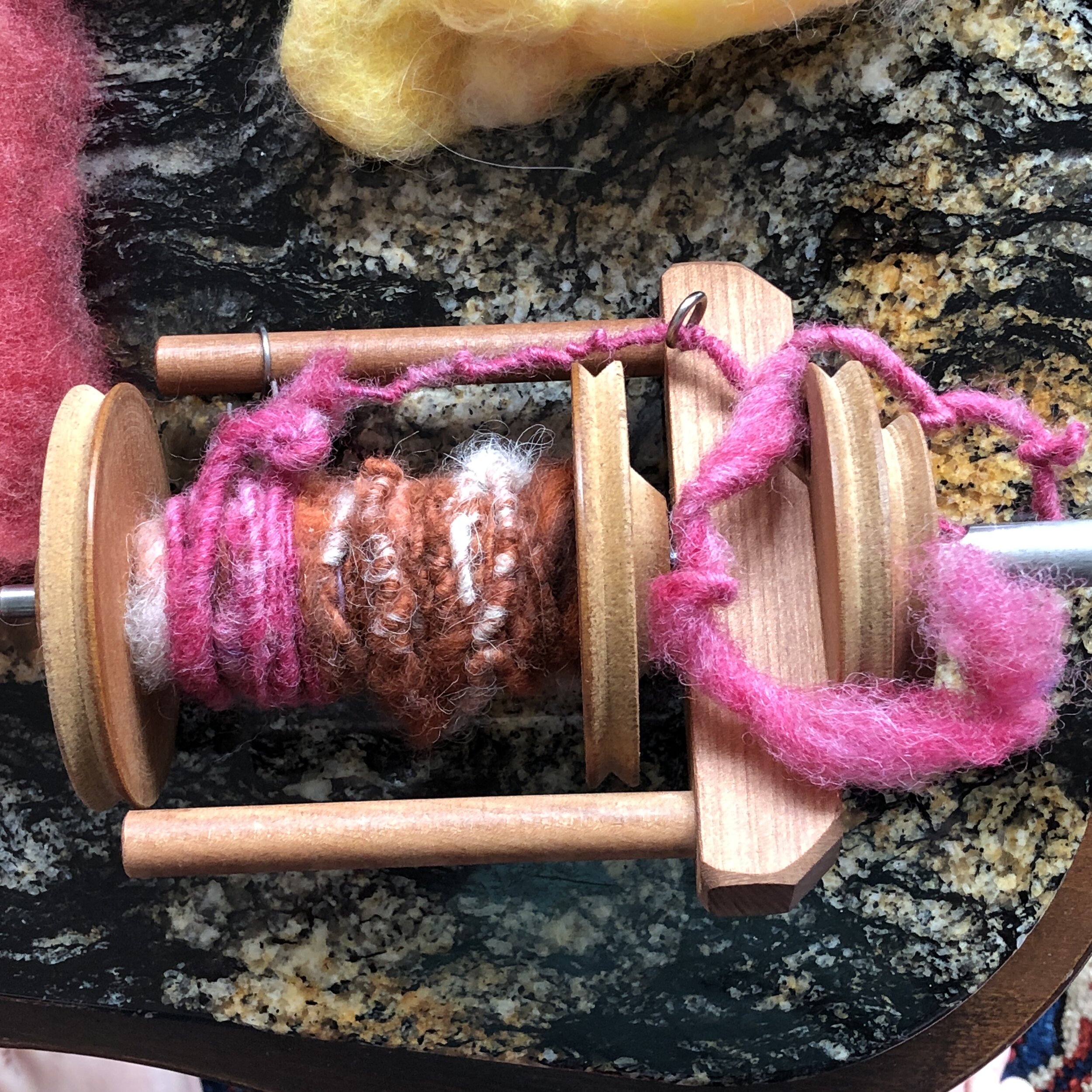
I pulled out the dyed roving, spun it and made a hat and a cabled headband. Wish I could find a picture of the finished pieces!

Next blog I will tell you about the Fiber Spinning Study group and me drowning in attempts to organize everything!